Blog Archives
Zooming Through the Looking Glass
The next several months could redefine the future of transportation in the 21st century.
The startup company Hyperloop Technologies — which takes its name from Elon Musk’s proposed invention but has no direct connection to him — announced today that it will build a test track for the ultra-fast transportation service in North Las Vegas, Nevada…The company plans to test its custom designed electric motor to speeds of up to 540 km/hour (about 335 mph) on a 1 km (about 0.62 miles) long track.
—, “The Hyperloop Will Begin Testing in Nevada in 2016”
Airfares continue to increase and flying attire and attitude have become far too casual, trains have limited rail systems and nobody wants to use (or at least admit) that they’ve traveled on a Greyhound bus. Like energy, alternatives to traveling from Point A to Point B are actively being explored. The Hyperloop is just the latest example that proves innovation is where the brightest future resides.
The consequence of living in a minute-to-minute (even second-to-second) society has undeniably reached the transportation sector. People crave immediacy.
Here is a video illustration of future travel that would break the (speed) limits as we know them today.
Ladies and gentlemen: The Hyperloop.
If the forthcoming tests during the first part of next year are positive for this Jetsons-like method of conveyance, the public’s reaction and inquiry will be aimed directly at Hyperloop’s team at 100 miles per hour.
Well, technically 335 miles per hour.
Our Attraction with the ‘Future’
First prize goes to Hendo Hover by Arx Pax.
Second place is awarded to SLIDE by Lexus.
While the interiors differ by way of a supercooling superconductor and the exterior designs differ in function versus luxury, the undeniable correlation between Arx Pax and Lexus is their dependent use of magnetism used to glide their respective hoverboard inches above the ground. Thus far, principles of physics have revealed magnets as the primary source of generating a hovering effect with a person riding a wheel-less skateboard above a metal/magnetic surface.
To create the illusion of a hoverboard Marty McFly might ride to perfect his riding and escaping skills, Lexus built a skate park in Barcelona, Spain with magnets underneath the surface and just below a sleek water strip. The promotional video for the company (which was devised to showcase its innovative prowess) will admittedly not lead to a hoverboard for purchase down the road (well, technically not for the “road”) or any further hovering parks. That’s a bummer.
Still, their finished product is pretty damn cool.
Arx Pax and Lexus clearly have the best taste in entertaining cinema and they also understand the wonderful power of dreaming big. We all wanted to travel to “2015” when we saw Back to the Future: Part II in movie theaters in 1989. Besides buying a pair of Nike power lace shoes (later this year!), wearing a power-drying jacket and getting our hands on “Grays Sports Almanac from 1950-2000,” we wanted a hoverboard. As our pop culture-driven scientists are in the alpha stage of developing an anywhere-anytime hoverboard, it’s exciting to be on any path that resides above the ground.
Every life-altering invention started somewhere stuck between limitation and doubt.
And then the future arrives…
Flying’s Hidden Future?
Cue Frank Sinatra’s, “Come Fly With Me.”
As American airports struggle to keep up with the modern and innovative designs of its architectural counterparts in foreign nations from all around the world, it appears as if the golden era of flying from the days of Pan Am and sophistication at 35,000 feet could be the creative source for a 21st century return to luxury in the skies.
Well, at least for the space where we wait to get on the plane.
It’s time to experience a hidden, closed-off terminal of JFK Airport in New York City.

(Photo by Max Touhey)
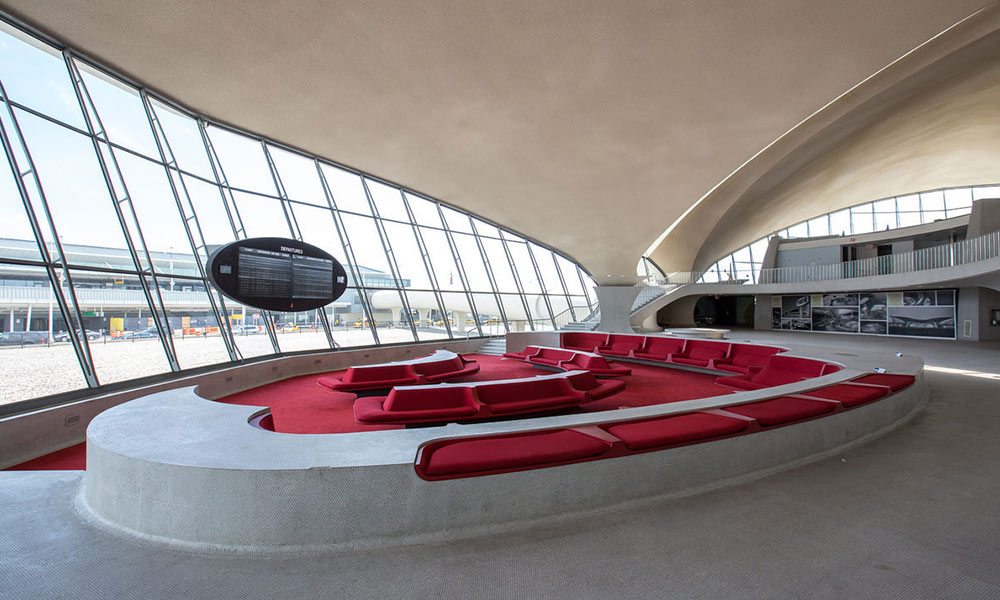
(Photo by Max Touhey)

(Photo by Max Touhey)
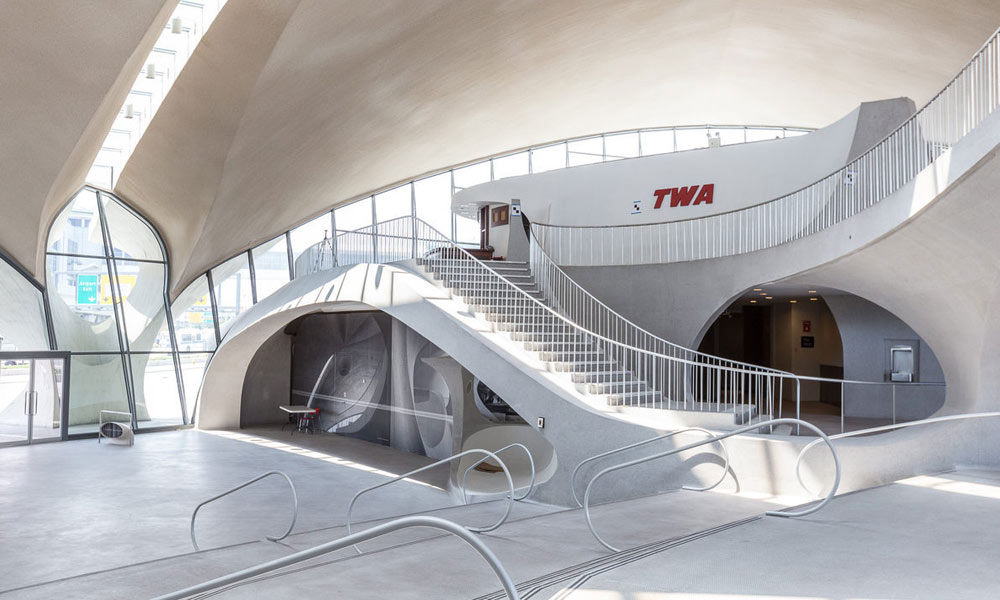
(Photo by Max Touhey)

(Photo by Max Touhey)
The seats are spacious and the layout is visually appealing. The lines (interior and exterior) are cool with nice dimension and the vibe is simplistically calming. More splashes of sharp colors should be added, along with more backs to seats and the area should be gadget-friendly with the latest technological features, but the basic framework is there. Even in its current form, it’s a welcomed call back to the moment in American history when flying wasn’t inherently stressful or a tornado of chaos, rudeness and sloppiness. Just the sight of this environment inspires class and a promise of a great journey and exciting escape.
Unfortunately, this gem from the past is set to be re-purposed into a fancy hotel. That’s not surprising. But going to a terminal in an airport like the one shown above in a happy mood and not trying to merely complete the taxing task of going from Point A to Point B (with layovers in Point C and D) would be rejuvenating.
It would be a smooth, worldly ride, if you will.
An Insanely Great Throwback Thursday
Saying “hello” has rarely been so profound.
In the spirit of “Throwback Thursday” and the Steve Jobs trailer that debuted yesterday, today’s blog post will take you back to the real Steve Jobs presenting the first Macintosh computer in 1984 to an audience in awe of a personal machine they and the world had never seen live before.
There are events in life when you instantly know everything’s about to change forever.
This was one of those moments.
 Jimmy's Daily Planet