Blog Archives
Are You Thinking What I’m Thinking?
“Shark Week” conjures up feelings ranging between amazement and paralyzing fear. Truly a cultural spectacle. As it has been mentioned in a previous post (The Two Scariest Words: Dun-Dun), all of mankind (and womankind) can collectively thank the legendary Steven Spielberg for permanently planting the unforgettable soundtrack and classic scenes into our psyche regarding blockbuster entertainment coupled with beach safety.
Actually, given the number of great white sharks near coastlines at popular destinations around the world, a thank you really is in order. Thank you!
One of the annual traditions with “Shark Week” is watching crews for The Discovery Channel push new boundaries, like exploring the present-day existence of Megalodon or the “Rookin'” down in Louisiana. What will be next?
I’m glad you asked.
What fascinates me is not so much what we think of sharks, but what sharks think of us. Within the technological revolution that is currently booted up for generations to come, is there a neuroscientist somewhere who is dreaming up a water-proof device that could be tagged onto a great white shark that somehow measures and sends back its brain activity?
Think about that. More importantly, imagine that.
Before you begin calling mental institutions to reserve me a room (with an ocean view please), watch the clip below and tell me this diver was not interested in a similar endeavor. It’s only unbelievable until you do it.
If we are going to explore a seemingly infinite environment, we must have an equally infinite imagination.
The Two Scariest Words: Dun-Dun
Since I missed the world premiere of, “Sharknado,” tonight’s encore viewing at 7:00 p.m. on the SyFy Channel will give me the opportunity do a full body dip into a world where sharks are swept up into a giant tornado and subsequently scattered throughout the terrified city of Los Angeles.
“Sharknado!”
Few things on this planet can paralyze people like a shark. Actually, few things on this planet can paralyze like the idea of a shark. Pause for a moment and reflect on that sentence…We do not need to visibly see or definitively know a shark is nearby to be struck with fear and for our heart’s to pound right through our bodies. We can all thank the brilliant Steven Spielberg for this.
Oceans are magnificent, full of everlasting mystery and intrigue. Anyone who has swam in the ocean along a coast or at a resort can attest that it’s a refreshing feeling. Most of us do not live by the ocean, so it’s an adventurous luxury. Still, how many of us venture farther than where we can touch our toes to the bottom?
It was about six years ago when my family and I went on vacation to Hawaii. The laid-back state in the middle of the Pacific Ocean is stunningly beautiful with exotic treats and gorgeous women at every turn…Anyways, my sister and I were coaxed into swimming about a quarter-mile into the Ocean by our Dad. Let me put it this way: there was zero chance of our feet touching the bottom.
And why did we explore well beyond the sandy beach? Because our Dad had heard that were whales nearby and he wanted to swim out to try to see them in all their massive glory. It as a once-in-a-lifetime experience.
Admittedly, whales were the last thing I was thinking about as we paced further and further from the beach. There was one thing on repeat the entire time in my head and it went like this…
During every single stroke of this watery trek, I was trying my best not to imagine all the creatures that lived in the ocean. I did my absolute best to rationalize that we weren’t really far enough from the beach to see a dorsal fin with a pointed top. I took as many deep breaths as any human being could to remain calm and not panic as I’m swimming with nothing but open water below my gliding body.
And then…
We saw something on the horizon break the ocean’s glassy surface. Looking more closely, it was a gigantic whale and we saw it slowly rise and fall back into the depths of the ocean. It was a majestic sight.
After basking in the glorious event, I quickly coaxed my sister and Dad to turn around and swim back (slowly and calmly) to the beach resort.
More than a decade ago, my family and I were on vacation down-under in Australia. Talk about an amazing country. One night in Darwin, we ate dinner at a wonderful restaurant at the end of a pier, which was about ten feet above the ocean. The food was delicious.
As we were walking back across the pier, my Mom told me to, cautiously, look down. A safe distance from the edge, I gently leaned over and saw the splash she was referring to. Puzzled, I asked her if it was just waves crashing? Why did she want me to see that?
She replied it wasn’t and told me to look more intently. I did and noticed something peering out of the water…it was a dorsal fin of a Great White Shark! Absolutely insane!
Initially, it startled me. Just a second or two later though, I was fascinated and completely in awe.
It’s somewhat mind-boggling how it’s the very idea of a shark, not necessarily the sight of one, that can strike a paralyzing fear and cause out-of-body heart pounding. This dynamic perfectly lends itself to being a superb psychiatric study.
Was there a big shark swimming relatively close to us during our oceanic adventure to see the whale in Hawaii? I have no doubt. And I didn’t have to see a fin for it to scare the hell out of me!
The Power of a Horse
Aliens. Great White Sharks. A whip-happy, gun-slinging professor of archaeology. Dinosaurs. A horse?
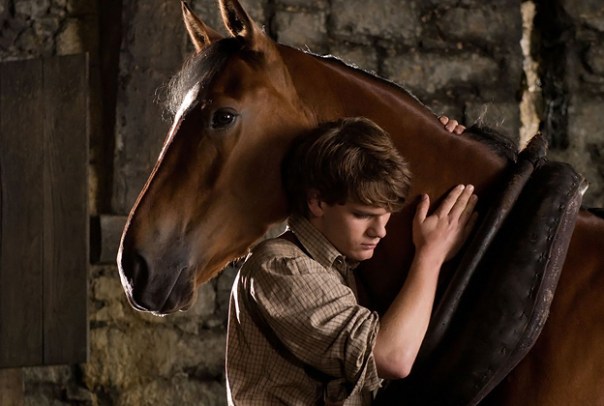
(Rolling Stone)
Steven Spielberg, one of the greatest movie directors of all-time, has introduced the public to a wide-range of characters, most of which grab our attention from the title’s alone. “Jaws,” “Indiana Jones and the Temple of Doom” and “Jurassic Park” are just a few examples. But what about, “War Horse”? First reactions do not stir up emotions of great excitement. It’s a story about a horse that was involved in World War I.
Okay…?
And yet, it is still Steven Spielberg after all. It is his impressive filmography that we can instinctively conclude that a great story is waiting to be told and that he is the perfect person for this job. Somehow, someway, we the audience will come to relate to a horse from a war. In some fashion, we will sympathize with a horse and be intrigued by its journey in a way similar to that of E.T.
Still though, this undertaking seems about as difficult as plowing a field scattered with rocks.
“War Horse,” to my surprise, is a beautifully tragic, yet inspirational story of unfaltering friendship. Throughout Joey’s life (the horse), he is connected to life all around him. As peculiar as it may read, Joey’s many relationships throughout his joyful and perilous journey resembled something remarkably close to kinship. Surprisingly, the love and admiration the various characters felt for Joey in their various situations was felt through the screen. We start to understand that a horse, in this instance, represents much more than a mere animal. Joey, to those who took the time, was profoundly more than power and dashing speed.
Watching this movie in the evening of Memorial Day was special. The themes of military service and, well, horses, sparked a flashback dating back generations. My Great-Grandfather, Albert C. Ziemann, served in World War I in the U.S. Cavalry at the independent age of 26. He registered for the draft out of Milwaukee, Wisconsin and was stationed in France.
The following are family recollections:
He was once in a weather observation balloon when it crashed into a French apple orchard. Like in the battle scene near the end of, “War Horse,” he too was gassed. Fascinatingly, General “Black Jack” Pershing (formally John J. Pershing) had, at one point, wanted a rare hawk of his to be stuffed. While asking up and down the ranks for an individual to assist him with this unique task, Ziemann, who enjoyed taxidermy as a hobby, volunteered his services to the General. For Ziemann, this was likely seen as a genuine win-win scenario because he would be doing taxidermy for the prestigious General and this job got him off the front lines.
Stuffing the hawk was expected to be a two-day assignment, but it stretched out to two weeks. One of the most incredible stories of Ziemann was that he helped General Pershing take care of his horses! It’s assumed this coincided with the two-week hawk-stuffing project. Regardless, what a tremendous honor and experience.
Members of my family have recalled that Ziemann enjoyed riding horses. One day in 1963, he had been riding horses. Devastatingly, later that day, he died of a heart attack. Despite the sadness of this memory, it is important because it portrays how his love of horses was not a two-week and/or temporary crush, but likely a lifelong love affair. The connection between a person and a horse is special and can endure in times of war and peace.
During this Memorial Day, in 2013, I found myself reflecting back to almost one hundred years into the past to my Great-Grandfather, Albert C. Ziemann, all the while relating his experiences to those told in the magnificent story of, “War Horse.”
From all of this, two things are certain:
I am very proud and amazed of my Great-Grandfather’s service during World War I.
And that Steven Spielberg is one hell of a storyteller.
Dinosaurs Aren’t the Only Things Jumping at You in 3-D
It’s a surreal sensation when walking into a movie theater for an 8:00 p.m. on April 5, 2013 showing feels like 1993…June 11th to be exact. Opening the doors to theater 12 served as a time travel portal from precisely twenty years earlier (give or take two months). As an anxious seven-year old in suburban Columbus, Ohio, my adventurous family and I drove the three miles to the AMC Movie Theater at Mill Run for the first premiere of “Jurassic Park.” The previews indicated it was about dinosaurs living in the modern era, but revealed virtually nothing else. Our minds were filled with an excited curiosity at what famed director Steven Spielberg and his team had created. Familiar with his universal classics, “Jaws,” “ET the Extra Terrestrial” and the Indiana Jones adventures, expectations were as tall as a, well, Brachiosaurus.
Just as fossils have proven the existence of extraordinary species of dinosaurs, Steven Spielberg’s decision to adapt one of the best movies from his illustrious director’s log into 3-D has also proven to be extraordinary. The audience saw a new dimension of special effects visionary and Academy Award Winner (Best Visual Effects: “Jurassic Park”) Stan Winston. We the spectators were put in the same position as Ellie when the Velociraptor burst through the floor to ceiling pipes after restarting the park’s electrical grid and Tim and Lex in the compound’s kitchen while being hunted by two raptors. The girl next to me actually jumped out of her seat when Ellie was attacked by the once hidden raptor! There are breathtaking scenes throughout the two hour cinematic masterpiece.
“Jurassic Park” and 3-D are a match made in heaven. Absolutely stunning!
Going to the movie theater to see the magnificent “Jurassic Park” in IMAX 3-D did put into perspective a new reality we now find ourselves. With as much hype that surrounded this re-release, it was an unknown variable as to how the public would respond. The verdict? According to Moviefone: $18.2 million! A pretty tremendous success for the first weekend of an updated re-release competing against movies with brand new content. Arriving forty-five minutes early secured the second spot in line. This was important because the number of people who stood patiently grew exponentially every five minutes until the usher opened the doors.
It’s here we arrive at the center of what transpired last Friday evening in a cultural sense. This singular showing saw multiple generations dedicate their Friday night to waiting and then watching a movie they probably own and first enjoyed twenty years ago. To repeat, twenty years ago. In a scenario between remaining at home to watch cable or experiencing the thrills of seeing a film on the silver screen, crowds of people chose the latter. The atmosphere was terrific.
Did Spielberg provide us with more than one cultural flashback?
The box office numbers combined with the eye test proved there is still a desire to be around other people by vacating the “comforts” of our own private space. Last Friday night felt like I was back in the 1990s with the huge crowd of anxious people spending their evening at the movies for the big premiere. Yet, there is still a problem lurking around movie theaters across the country.
15.50
By its lonesome, it signifies nothing. However, with a $ before it, the solitary number becomes a value. It happened to be the price of the ticket of admission for the IMAX 3-D version of “Jurassic Park.” While standing in line, I wondered what the average ticket price of a movie was back in 1993. I researched it on my phone and the internet spit back ~$4. Okay, now how about 1973? ~$1.77. Groovy! Apparently, ticket prices are doubling every twenty years. The $15.50 was the cost of the most expensive ticket for this rare re-release, so don’t equate this number with the average price today. The average ticket price for a new major motion picture in 2013 is ~$8.
Paying up for a 3-D movie in IMAX is one thing, but the price for any new release is cause for reflection on the here and now compared to the not-so-distant past.
The instinct to physically venture off to a movie theater is still ingrained in the film loving mind of the American people. But at what cost? There will be a breaking point in how much a family or group of friends will spend on a night out at the movies. Anything more than $5/ticket to me is asking too much that does not involve 3-D or IMAX. We are currently at $8. The definitive red line for most families will almost certainly be $10/ticket: double digits.
Simply going to the theater on a whim one evening to see the new movie is no longer an affordable protocol due to the exorbitant prices, from teenagers to adults. Funds have to shifted around. By the way, the snacks have not even been purchased yet…anybody have a twenty?
And in today’s world, one of the most horrific questions has to be pondered by thousands while standing in the “twilight zone” of the lobby of any theater around the country. This is the area between the concession stand and the hallways for the individual theaters. Anything can happen here, for better or worse. For those precious few seconds, we all have been forced to ask: “Do we really need popcorn?” This proposition is enough to send me into shock, no joke. We all know prices are too high when this question is asked. No popcorn at the movies!?
“Houston (& everywhere else), we have a problem!”
My Mom and I used to have our own “movie marathons” to see new movies for a week or so during the summer when I was a kid. Movies, popcorn and a soda. This scenario, sadly, is virtually impossible today. The movie theater is supposed to be for everybody in the community on any give day and time to escape for a couple hours. Like those $4 tickets, spur of the moment “movie marathons” appear to be another relic of yesteryear.
“Back when I was your age, going to the movies cost ~$10 and included a popcorn, small drink and change for the arcade.”
If ticket prices for movies become too high, then fewer people will go to movie theaters and enjoy the atmosphere filled with wonderment whilst in the company of fellow movie lovers. A negative connotation will emerge for movies in general. The problem the major studios face is, ironic to the politically vocal celebrities in Hollywood, exactly what is occurring on Wall Street. The profits for the big studios and its beneficiaries are astronomical, at least in the hundreds of millions of dollars. Yet, the public continues to pay more than they ever have for reasons unknown. Yes, it costs more to film in 3-D and/or IMAX, but somewhere in this monetary cycle the revenue is being directed where it shouldn’t and we’re all paying for it.
People want to be gregarious. Thankfully, the magic of going to the movies on a Friday night is still there. However, movie studios and the deal makers involved better not take the public’s long history of excitement and commitment of paying to see newly released major motion pictures for granted. People and memories are not numbers on a spreadsheet. If the current inflationary trend is not reversed, then movie theaters could become extinct.
Hopefully in 2033, a coming attraction won’t be titled, “Jurassic Theater.”
Good luck with that.
 Jimmy's Daily Planet