Blog Archives
I Have a Question…Actually, I Have More Than One
Why do we watch? Despite the fact it’s become a cultural phenomenon to millions of people, why do we, individually, sit on a couch and decidedly press the buttons on the controller that take us to The Discovery Channel for “Shark Week?” To discover something new I suppose.
“Shark Week,” in the literal sense, is a week of documentaries and informative stories about sharks, their habits, dangerously incredible close-ups, new revelations and so forth. In the metaphorical sense, it’s an opportunity over several days to revert back to our instincts of elementary school. What does this mean exactly? Reflecting on our experiences from kindergarten through the fifth grade, one of the constants was our insistence to learn as much about something that peeked our interest as possible. Whether it was sharks, bears, insects, adventures in books, sports, math, Sega Genesis, Nintendo, science, etc., we were hooked. We were not just thirsty for Capri Sun, but also for knowledge.
The amount of information we wanted to absorb was boundless. Do you think I’m wrong? If you have any nephews, nieces, sons or daughters around the preschool to elementary school age, try to compute just how many questions they ask you about anything and everything on a daily basis. Why? Why? Why!?
It’s their nature. It’s instinctive. Nobody tells them at a young age to ask a limitless amount of questions. They just do. Then, during the teenage years of our lives, we transition to a phase when we don’t seek as many answers to questions that are academically related. At some point though, we cycle back around to find the glow of knowledge from our younger days that rejuvenates an inner spark and desire to want to learn about what surrounds us and how everything works.
Who? What? When? Where? Why? How?
Some of you may be wondering why there were so many questions asked throughout this post? Because if nobody asks questions, how do we discover anything new? How do learn where we come from? How do we know where we are going? Where do great white sharks mate? Do sharks really mistake humans for seals? How do painters dream up their masterpieces? Do aliens exist? Will somebody ever invent a teleportation device? How has there not been a new “Bill & Ted’s” adventure made in more than twenty years?
This week, it’s sharks. What will it be tomorrow? The day after that? Next week?
Good question.
Are You Thinking What I’m Thinking?
“Shark Week” conjures up feelings ranging between amazement and paralyzing fear. Truly a cultural spectacle. As it has been mentioned in a previous post (The Two Scariest Words: Dun-Dun), all of mankind (and womankind) can collectively thank the legendary Steven Spielberg for permanently planting the unforgettable soundtrack and classic scenes into our psyche regarding blockbuster entertainment coupled with beach safety.
Actually, given the number of great white sharks near coastlines at popular destinations around the world, a thank you really is in order. Thank you!
One of the annual traditions with “Shark Week” is watching crews for The Discovery Channel push new boundaries, like exploring the present-day existence of Megalodon or the “Rookin'” down in Louisiana. What will be next?
I’m glad you asked.
What fascinates me is not so much what we think of sharks, but what sharks think of us. Within the technological revolution that is currently booted up for generations to come, is there a neuroscientist somewhere who is dreaming up a water-proof device that could be tagged onto a great white shark that somehow measures and sends back its brain activity?
Think about that. More importantly, imagine that.
Before you begin calling mental institutions to reserve me a room (with an ocean view please), watch the clip below and tell me this diver was not interested in a similar endeavor. It’s only unbelievable until you do it.
If we are going to explore a seemingly infinite environment, we must have an equally infinite imagination.
Extreme Makeover: Knowledge Edition
Upon first glance at today’s cover page on bing.com, I was baffled. As is protocol with viewing Bing’s daily front page, I scrolled over the image to navigate to one of the four informational boxes. The link took me to a collection of pictures of the University of Zurich Library.
Stunning.
The big, dramatic curves guide your eyes within its grandiose space. This description is hardly ever used to characterize a library. Most of us know libraries to be very quiet, calm and non-exciting. The need for such fancy, eye-catching exterior and interior designs is considered nonsense when referring to a place to read, write and study.
Maybe this is the problem.
Books, periodicals, research journals, magazines, movies and so forth remain popular commodities with the public for various reasons. Despite the demand and ample supply on the shelves, libraries are rarely packed from wall-to-wall, unless it’s mid-term or finals season. As a solution, I suggest more libraries search out for private investment collaborations. Specifically, imaginative minds, inventors and architects who would jump at the opportunity to make his or her mark. Living in the age of information (ie- digital technologies), libraries offer an outstanding and nearly unlimited resource for people to invest their time and energies to further their education and personal enlightenment.
Think of it as “the knowledge renaissance.”
It’s time to view libraries as not just a building filled with old books and shushing librarians, but instead a destination of learning. In other words, it’s time to follow the lead of some around the United States and the world in their recent and historic efforts to boldly brand libraries as, generally speaking, “a cool place to be.” The silence must be upheld, along with the other proper rules and norms for any library. Learning and expanding one’s mind still need to be the predominant objectives. The primary difference is making the trip to the library an experience for people of all ages with dynamic and innovative educational value, attraction and content.
To better illustrate my point, below is a small collection of some creative takes on the library:
 (Keystone/Gaetan Bally)
The University of Zurich Library
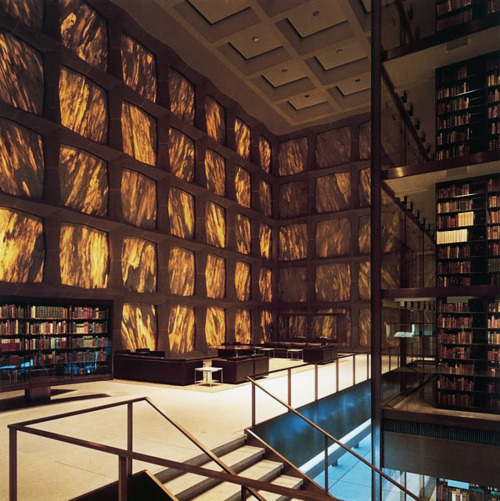 (STUA on Tumblr)
Yale University’s Beinecke Rare Book and Manuscript Library

(princetonreview.com)
Arnold Bernhard Library at Quinnipiac University
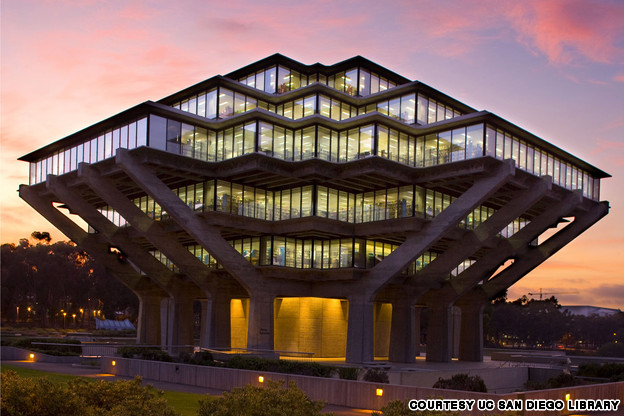 The Library at the University of California at San Diego

 (myloc.gov)
The Library of Congress
Above are only a few examples of how architects throughout history have defined libraries as spaces intended for learning whilst being surrounded by magnificent inspiration. Hopefully, the future will feature creative minds who expand on past and present designs (there really is something truly special about those old world libraries and the history they speak to its visitors…). Architects could also innovate these themes with entertaining and engaging technologies with the aspiration of uniting communities and people all around the world towards the journey of abundant knowledge and unparalleled perspective.
How does that phrase go, “if you build it, he will come.”
With all the technological advancements and varying mediums for sharing and presenting information, the grand opportunity to innovate, reinvigorate and redirect the public to the library in masses is undeniably present. Could this mean holographic shows with famous historical figures? Perhaps. There are seemingly countless possibilities. The key is finding and connecting with eager and imaginative men and women (like Ted Mosby, formerly of Mosbius Designs) to collaborate with to build these kingdoms of knowledge.
Kingdoms of knowledge…sounds like an adventure already.
 Jimmy's Daily Planet