Blog Archives
“The Goldbergs” is Television Heaven
“So it does involve treasure.”
Spoiler Alert: This is a recap of The Goldbergs from January 14, 2014.
We all remember being in high school and taking part in college fairs and enjoying the wild circus known as class elections. The latter consisted of our fellow classmates who would state their positions on various issues and makes sensible, reasoned promises like building a two-story winding water slide that splashes into the cafeteria where there would be a free towel and soda waiting for us to quench our thirst before biology.
Then, the kids finally told their parents to stop helping them with their campaigns.
Beverly and Betsy, this means you.
And there may be no better example of maternal love and support of all things motherly on television than the incomparable Beverly Goldberg. Whether this involves scaring her son away from his interest in the University of Hawaii by saying the school is surrounded by sharks or by hanging blown-up, embarrassing pictures of her son in every hallway of his school for everyone (including his blonde crush) to see with an image that’s downright unforgettable.
Beverly Goldberg is “a shoulder-padded, crunchy-haired mother warrior.”
While Barry was enduring the high-stakes game of high school politics (with and without berry bombs), Erica and Adam each had their own crisis to confront.
Erica, a former model student in the classroom (just not in Senegal), was confiding in her unwilling Pops with a pastrami sandwich about how she had been successfully scamming her Mom about all the extracurricular activities she was boasting on her college application. This reveal caused an uncomfortable, but therapeutic, flashback of her days in the Model U.N.
She was studious. She did lots of work. She was a mini-Beverly driven by an unrelenting Type A personality. This ultimately led to a battle between Libya and Senegal that could not be resolved peacefully.
This inner conflict led to Erica resigning from the U.N. (but not on her application, of course) for a much cooler, laid back approach to academics and life in general.
She had checked out, which brings us to Adam and his Dad at the Video Heaven movie store.
Yes, there was a glorious time in the history of Mankind when men, women and children would dare to leave the comfort of their own homes and venture off to a video store where they would walk through a maze of movies (new and old) in search of “the one.” But, the catch was there needed to be a VHS or DVD behind the empty cover box on the shelf. If not, Friday night was a bust. Game over.
All was lost, including one’s very soul…at least until the next day when the shelves were hopefully restocked.
There was always the return bin, but that was the last resort. Most importantly, or at least on the same level as “Be Kind, Rewind,” was the existence of the late fees. Murray Goldberg realized the horrible ramifications for not returning a movie on-time: a bullet through his wallet!
A dejected Adam, who had discovered an Indiana Jones in the return bin, was denied by the clerk because of an outrageous fine to his Dad’s forgetfulness to return the Paul Newman-led movie masterpiece Slap Shot, unleashed a fury on Murray that seemed impossible to resolve.
Incredibly, with the odds against each of the Goldbergs (except for the preoccupied, sandwich eating Pops), each found his and her inspiration and strength in doing the uncomfortable.
Barry decided to start caring about his campaign for Treasurer by publicly denouncing his Mother’s insanity and all mothers’ insanity to great applause, fanfare and an impossible victory, Erica chose peace and reconciliation with the Model U.N. and with her personal struggle with Senegal and what that country represented to her, Beverly took her foot off the pedal of a high school class treasurer’s race along with her battle for parental supremacy with arch rival Betsy, Murray paid his outrageous fine (though the math did add up) and Adam forgave his Dad for a lost night of action, adventure and all-around Harrison Ford greatness.
For Murray, swallowing his pride, admitting he was wrong to someone outside his immediate family and doing something unforgettably nice for his son Adam (for two months anyways) was one heck of a long shot. Some may even argue it symbolized a last second, seemingly impossible slap shot to win the game…
Adam had in his hands an official card to Video Heaven with 50 prepaid rentals. For those of us who remember such cards, it was a moment of pure bliss and awesomeness.
Maybe listening to Toto will bring us to the yellow brick road where it will, in a surreal sense, lead us back to our own Video Heaven.
As a former patron and employee at Blockbuster, this episode rang especially true. The movie store scenes rewound cherished memories of restocking new releases and classics and of manning the computer/register in the front to eager movie watchers of all ages, day and night (plus an Olympian).
It was a great job making people’s cinematic dreams come true!
There’s no place like Blockbuster, there’s no place like Hollywood Video, there’s no place like a video rental store!
…Sorry, I Just Zoned-Out for a Minute
The mere passing of time has a funny way of evolving the things in our daily lives. Add in the fact that humans have long proven they will innovate to varying degrees (and yes, I am aware of The Dark Ages) during a certain amount of time. Whether in days, weeks, months, years or decades, familiar things change. Incentives arise. Reality is altered for the future. This can pertain to a myriad of items or even entire environments.
It can also involve stories.
The Secret Life of Walter Mitty is not a new story by any stretch of the imagination. However, the version known to a particular generation varies. For instance, there are two movies derived from the famous James Thurber short story of 1939 of the same name, one in 1947 and one recently released in 2013.
Same title, different interpretation.
Part of this distinction between the two major motion pictures is due to the year it was produced and the world we lived in and are currently living in at the moment. Another prominent factor is not only the technology available, but also filmmakers trying to define who Walter Mitty would be back then and today. Where would he live? What would he do for a career? What or who does he dream about and why?
Below are two trailers for the two film adaptations of the Thurber classic.
Same character, different time.
Do you know a Walter Mitty? Are you Walter Mitty?
Only time will tell.
FYI: Friday is a pretty good day to find out either way…
P.S. Walter Mitty in 2013 is well-worth daydreaming about in a movie theater for a couple hours.
Reintroducing a Classic
Through all of the variations of Superman, whether in cinema, television or comic books, Christopher Reeve established himself as the standard bearer 35 years ago. The richness Reeve brought to life in Clark Kent/Superman, and his superb supporting cast, has defined this movie from the ’70s as a classic well into the digitally-driven 21st century. We the audience did not simply watch in awe as a powerful man flew through the air and battled bad guys, but instead got caught up in a heroic story and a love story involving another world and people and a particularly feisty Daily Planet reporter. Terrific elements of realness and fantasy intertwined, which potently lifted Superman off the 2D screen into our hearts and imaginations.
Will 2013s, “Man of Steel” have the same impact as 1978s, “Superman”?
Richard Donner cared about Clark Kent/Superman, Lois Lane, Jimmy Olsen, Mr. White, General Zod, Lex Luthor and so forth. His dedication to showing us a story about Superman instead of telling us was just one of the many “it” factors that has cemented, “Superman” as the best movie thus far about the man with the “S” on his chest.
We cared because he cared.
The story for “Man of Steel” was written and concocted by David Goyer and Christopher Nolan (both of “The Dark Knight” trilogy). Below is an interview with Mr. Goyer.
The paramount question: Did Goyer and Nolan write a screenplay and create a story that Superman fans from multiple generations will care about in 2013?
The Power of a Horse
Aliens. Great White Sharks. A whip-happy, gun-slinging professor of archaeology. Dinosaurs. A horse?
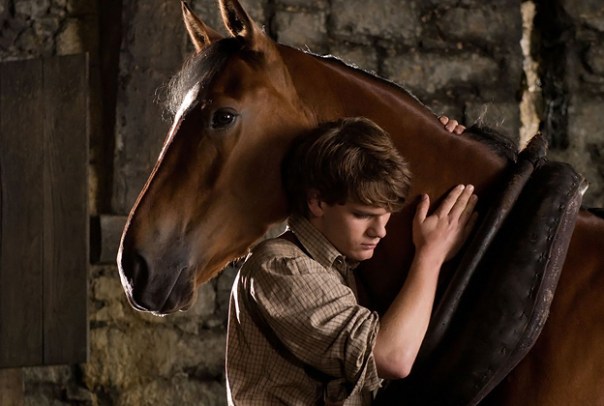
(Rolling Stone)
Steven Spielberg, one of the greatest movie directors of all-time, has introduced the public to a wide-range of characters, most of which grab our attention from the title’s alone. “Jaws,” “Indiana Jones and the Temple of Doom” and “Jurassic Park” are just a few examples. But what about, “War Horse”? First reactions do not stir up emotions of great excitement. It’s a story about a horse that was involved in World War I.
Okay…?
And yet, it is still Steven Spielberg after all. It is his impressive filmography that we can instinctively conclude that a great story is waiting to be told and that he is the perfect person for this job. Somehow, someway, we the audience will come to relate to a horse from a war. In some fashion, we will sympathize with a horse and be intrigued by its journey in a way similar to that of E.T.
Still though, this undertaking seems about as difficult as plowing a field scattered with rocks.
“War Horse,” to my surprise, is a beautifully tragic, yet inspirational story of unfaltering friendship. Throughout Joey’s life (the horse), he is connected to life all around him. As peculiar as it may read, Joey’s many relationships throughout his joyful and perilous journey resembled something remarkably close to kinship. Surprisingly, the love and admiration the various characters felt for Joey in their various situations was felt through the screen. We start to understand that a horse, in this instance, represents much more than a mere animal. Joey, to those who took the time, was profoundly more than power and dashing speed.
Watching this movie in the evening of Memorial Day was special. The themes of military service and, well, horses, sparked a flashback dating back generations. My Great-Grandfather, Albert C. Ziemann, served in World War I in the U.S. Cavalry at the independent age of 26. He registered for the draft out of Milwaukee, Wisconsin and was stationed in France.
The following are family recollections:
He was once in a weather observation balloon when it crashed into a French apple orchard. Like in the battle scene near the end of, “War Horse,” he too was gassed. Fascinatingly, General “Black Jack” Pershing (formally John J. Pershing) had, at one point, wanted a rare hawk of his to be stuffed. While asking up and down the ranks for an individual to assist him with this unique task, Ziemann, who enjoyed taxidermy as a hobby, volunteered his services to the General. For Ziemann, this was likely seen as a genuine win-win scenario because he would be doing taxidermy for the prestigious General and this job got him off the front lines.
Stuffing the hawk was expected to be a two-day assignment, but it stretched out to two weeks. One of the most incredible stories of Ziemann was that he helped General Pershing take care of his horses! It’s assumed this coincided with the two-week hawk-stuffing project. Regardless, what a tremendous honor and experience.
Members of my family have recalled that Ziemann enjoyed riding horses. One day in 1963, he had been riding horses. Devastatingly, later that day, he died of a heart attack. Despite the sadness of this memory, it is important because it portrays how his love of horses was not a two-week and/or temporary crush, but likely a lifelong love affair. The connection between a person and a horse is special and can endure in times of war and peace.
During this Memorial Day, in 2013, I found myself reflecting back to almost one hundred years into the past to my Great-Grandfather, Albert C. Ziemann, all the while relating his experiences to those told in the magnificent story of, “War Horse.”
From all of this, two things are certain:
I am very proud and amazed of my Great-Grandfather’s service during World War I.
And that Steven Spielberg is one hell of a storyteller.
 Jimmy's Daily Planet