Blog Archives
Extreme Makeover: Knowledge Edition
Upon first glance at today’s cover page on bing.com, I was baffled. As is protocol with viewing Bing’s daily front page, I scrolled over the image to navigate to one of the four informational boxes. The link took me to a collection of pictures of the University of Zurich Library.
Stunning.
The big, dramatic curves guide your eyes within its grandiose space. This description is hardly ever used to characterize a library. Most of us know libraries to be very quiet, calm and non-exciting. The need for such fancy, eye-catching exterior and interior designs is considered nonsense when referring to a place to read, write and study.
Maybe this is the problem.
Books, periodicals, research journals, magazines, movies and so forth remain popular commodities with the public for various reasons. Despite the demand and ample supply on the shelves, libraries are rarely packed from wall-to-wall, unless it’s mid-term or finals season. As a solution, I suggest more libraries search out for private investment collaborations. Specifically, imaginative minds, inventors and architects who would jump at the opportunity to make his or her mark. Living in the age of information (ie- digital technologies), libraries offer an outstanding and nearly unlimited resource for people to invest their time and energies to further their education and personal enlightenment.
Think of it as “the knowledge renaissance.”
It’s time to view libraries as not just a building filled with old books and shushing librarians, but instead a destination of learning. In other words, it’s time to follow the lead of some around the United States and the world in their recent and historic efforts to boldly brand libraries as, generally speaking, “a cool place to be.” The silence must be upheld, along with the other proper rules and norms for any library. Learning and expanding one’s mind still need to be the predominant objectives. The primary difference is making the trip to the library an experience for people of all ages with dynamic and innovative educational value, attraction and content.
To better illustrate my point, below is a small collection of some creative takes on the library:
 (Keystone/Gaetan Bally)
The University of Zurich Library
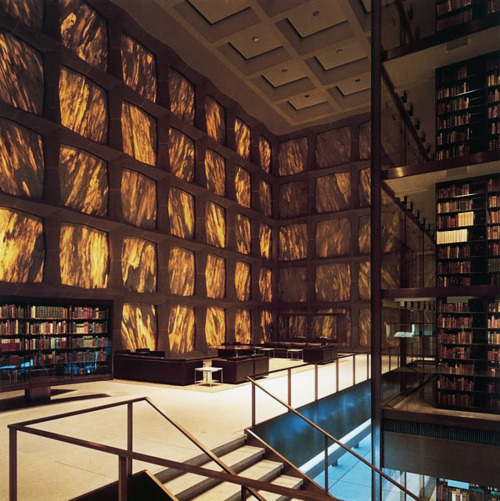 (STUA on Tumblr)
Yale University’s Beinecke Rare Book and Manuscript Library
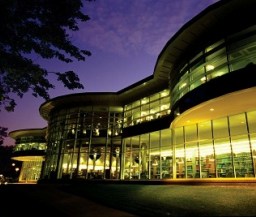
(princetonreview.com)
Arnold Bernhard Library at Quinnipiac University
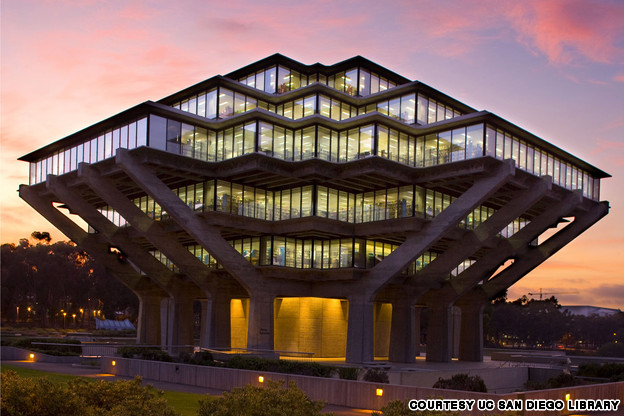 The Library at the University of California at San Diego
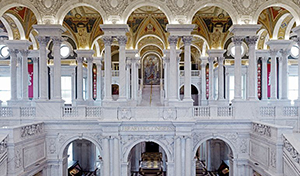
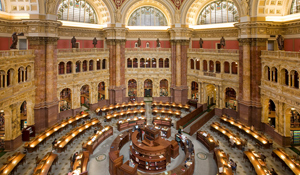 (myloc.gov)
The Library of Congress
Above are only a few examples of how architects throughout history have defined libraries as spaces intended for learning whilst being surrounded by magnificent inspiration. Hopefully, the future will feature creative minds who expand on past and present designs (there really is something truly special about those old world libraries and the history they speak to its visitors…). Architects could also innovate these themes with entertaining and engaging technologies with the aspiration of uniting communities and people all around the world towards the journey of abundant knowledge and unparalleled perspective.
How does that phrase go, “if you build it, he will come.”
With all the technological advancements and varying mediums for sharing and presenting information, the grand opportunity to innovate, reinvigorate and redirect the public to the library in masses is undeniably present. Could this mean holographic shows with famous historical figures? Perhaps. There are seemingly countless possibilities. The key is finding and connecting with eager and imaginative men and women (like Ted Mosby, formerly of Mosbius Designs) to collaborate with to build these kingdoms of knowledge.
Kingdoms of knowledge…sounds like an adventure already.
And Action!
Superman is the greatest superhero in history.
This entry will focus on the latter portion of this statement because as the 2013 cinematic version of the, “man of steel” is only days away from re-entering Earth’s atmosphere and psyche, understanding where this inspirational icon has come from is critical to appreciating where he is today.
About 63 years ago, George Reeves entertained television audiences with his clean-cut image of Superman. Then, the world in 1978 saw Christopher Reeve prove to be definitively everything Clark Kent/Superman to movie audiences of all ages. A couple more actors since have added their personalities to this character and this Friday British actor Henry Cavill will be debuting his take to the public.
Below is a collection of clips from a Superman documentary, tracking the television and movie actors up to Christopher Reeve look-alike Brandon Routh in 2006s, “Superman Returns.” It’s remarkable to see how one character from a comic book published 75 years ago has changed and sustained decade after decade after decade to bring rejuvenated hope to the people of Earth.
With, “Man of Steel” about to premiere to the worldwide audiences, watch the short video and reminisce on all things Superman. All the while, ask yourself if you think this superhero is trending in the right direction.
And also watch a trailer for, “Man of Steel” again and compare and contrast what George Reeves and his television show did in the 1950s to what Warner Bros. is doing today in 2013.
Super indeed!
Our Nation’s Artists
This morning I needed a light jacket. Normally, this isn’t a big deal except for the fact it’s June 7th. I guess Mother Nature decided to take a refreshing breath mint or two and blow her new-found coolness across the Midwest.
Just a little global cooling to make Al Gore go crazy for a few days.
Inexplicably, this cold front in June sparked random curiosity and wonderment of Americans from yesteryear…like yesteryear.
Having always been fascinated with history, this sudden reflective contemplation to the past patriots who lived in this country one hundred to two hundred and some odd years ago is not too surprising a revelation. Still, it’s noteworthy to think so far back in time without taking part in a tour or sitting in a history class.
Speaking of a historical tour, I have fond memories of visiting Colonial Williamsburg in Virginia, soaking in all the astonishing buildings, artifacts, food, people, gardens, modes of transportation and anything and everything found within its parameters. Uniquely American, it opened my eyes into the improbable inception of the United States of America and the ambiguous journey everyone took part in together in building the foundations of a new nation. An insightful quote by Martin Luther King, Jr. illustrates this courageous endeavor taken by our adventurous ancestors.
“Faith is taking the first step even when you don’t see the whole staircase.”
When my family and I visited Colonial Williamsburg, it was summer and it was hot. Not warm with a light cloud of humidity or it might be hot enough to swim, but, “Dog Days of Summer” hot. While partaking in the exercise of sweating and walking, there were countless Revolutionary soldiers and townspeople dressed in traditional late-1770s clothing. The attire was heavy and assuredly sweltering, yet they never showed discomfort. And here I was, in shorts and a t-shirt, feeling hot and uncomfortable. I made damn sure to shape up and wipe my brow when walking by the cannon operators!
Like Washington, D.C., Colonial Williamsburg should be a national requirement for all students to visit. The sights and sounds are spectacular and together creates an unforgettable experience and appreciation for our forefathers and foremothers and everything they endured to build the great nation we live in today. When it was hot, they sat on their porch or ran around outside and enjoyed the company of their family and neighbors. Some maintained their luscious gardens filled with colorful flowers and delicious fruits and vegetables while others socialized in stores around the town they all helped to build and support.
Despite the fact Colonial Williamsburg is not a quick stroll down the road, the Ohio Village is within a short driving distance. This is a place frozen in time dating back to the 19th century. Located in the shadows of Crew Stadium, the Ohio History Center and this thing they call a, “freeway,” the Ohio Village offers its patrons a momentary break from 21st century realities to visit the forever sought after and admired, “much simpler time.”
When it was too hot to stay inside, they went outside. When it was too cold to be outside, they stayed in, bundled up and made a fire. And when it was dark and they needed light, they lit candles. Our American ancestors were resourceful and did what they had to, whatever that meant. What’s more is whether it was during the 18th or 19th centuries, Americans have managed to pull off truly remarkable achievements. They took a blank page on a shaky canvas and, during their time, added their individual paint strokes and color splashes to create the foundation of the masterpiece we all see and enjoy today known as the United States of America.
Pretty cool, right? I get chills just thinking about it.
And come the fourth day in July, I know I’ll get goosebumps in the unrelenting heat while gazing up at fireworks in the same way our nation’s forefathers and foremothers did: celebrating the incomparably brilliant idea that is the American dream.
 Jimmy's Daily Planet