Blog Archives
Time to Fold on TV
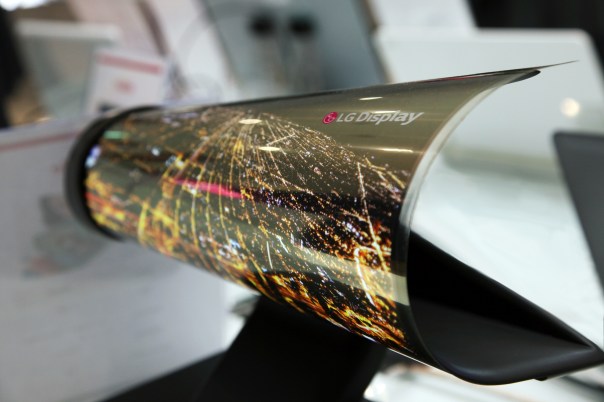
(LG Display)
“The company will also showcase futuristic concept displays that highlight the dynamic forms that OLED can achieve, including the world’s first 30R 18-inch rollable display that can be rolled-up like a newspaper…”
(LG Press Release)
The January 4, 2016 press release from technology giant LG (Life’s Good) disclosed many exciting products in-and-out of development for the annual forward-thinking Consumer Electronics Show in Las Vegas. Specifically, the OLED screen that bends with impressive flexibility and resolution presents a unique opportunity for a more convenient future.
As phones and tablets continue to increase in size and inflexibility (iPad Pro, damn), there is a natural instinct to ponder if a Zack Morris phone-wave is upon us?
Keep in mind that retro is always in style, especially the nineties.
Fortunately, LG may have just changed shrunk rolled the game back to size while peeking forward towards what may be commercially sold during the forthcoming third decade of the 21st century.
Envisioning LG’s flexible screen for televisions makes anyone impossibly curious about how TV-watching will change in the future. The question that comes to mind is if we (consumers) will actually have the option to roll up a high-definition TV like the Wall Street Journal and carry it to any flat surface in our home and simply stick it up like a magnet on a fridge?
Crazy.
The even crazier question: Who’s been bringing the Fruit Roll-Ups to LG’s innovation lab?
The Pursuit of Levitation
Apparently, now is the right time to hover.
Scheduling my ride on the first-ever hoverboard last Friday was born out of availability and great airfare. It never dawned on me that the subsequent week would reveal the first glimpse of the world’s second hoverboard: SLIDE.
Utilizing similar principals of magnetism, the specialized design group at Lexus has dipped its toe into the water (well, technically in the air) of hover technology following Arx Pax and their pioneering Hendo Hoverboard. Still, the specific components between the Hendo and Lexus hoverboards are distinguishable enough.
“Lexus said the test hoverboard in its “Amazing in Motion” campaign generates magnetic levitation by combining the effects of liquid nitrogen-cooled superconductors and permanent magnets” (USA Today).
Appearance wise, the hoverboard by Lexus is sleek and appears consumer-ready. Functionality wise, however, is still a lingering question. Looks like October 21st of this year will reveal that verdict, the same day Marty McFly quickly found out the answer to this question. Also, Hendo does not use liquid nitrogen-cooled superconductors, which is important to note for a couple reasons. First, both companies have legitimate claims to creating original hovering technologies, however similar the role magnets are to flotation. Second, it’s wonderful to see there is more than one way to build a hoverboard.
The creative minds at Hendo and Lexus, developing this desired mode of transportation out of nostalgia for the future (it makes sense), are in the alpha stage. Envisioning what the beta stage and beyond will produce is exciting as reductions in cost (Hendo’s board costs $10,000), battery life improvements and infrastructure will undoubtedly become focal points of business plans going forward. Perhaps this leads to a small skate park with magnets built underneath in the next few years (Lexus did that for the video above), then a long pathway around a park and then Marty’s daring and boundless flight throughout a town square will be reality soon thereafter.
Except over water.
The power of movies (and love for the BTTF fan) is inspiring for many reasons. Despite living in 2015 without most of the cool advancements featured in Back to the Future Part II, those scenes have clearly made a permanent impression on fans and innovators alike as a future to strive for and build towards. That’s incredible. The sparks of innovation can literally come from anywhere.
And Lexus seems to be opening a future debate: Will consumers buy a luxury car or a luxury hoverboard?
They may be surprised by the answer.
Television’s Newest Attraction
Put up this wall!
While President Reagan was absolutely right to boldly declare the Berlin Wall be torn down on June 12, 1987, LG was right to present the world with an inventive wall to build of their own a couple days ago in Seoul, South Korea nearly 28 yeas later in 2015.
LG Display, which is a subsidiary of the tech giant LG, recently revealed a product that will surely become standard in future homes: a wallpaper television. And it’s precisely what it sounds like. Measuring less than a millimeter in screen thickness, this prototype wallpaper TV virtually blends right onto the wall where you hang it. Using a magnetic pad of equal size (55-inches), the shockingly light 4-pound television adds unprecedented versatility to television watching and entertainment ventures.
The OLED quality colorfully defines this spectacular innovation.

(PC Magazine)
Whether speaking about this type of invention with friends and family or writing on Jimmy’s Daily Planet in the past few years about how entire walls in homes will someday (in the not so completely distant future) be screens that will be conducive to watching television, playing video games, displaying art portraits, being cloud-friendly, a home control center, etc., this is a genuinely exciting moment. Forget about the astronomical price this TV would demand right now because most innovations are too costly to the consumer, until they’re not.
Now the actual business element of LG Display will begin with a dialogue with the design team. The next challenge is offering this as an affordable product to the public in the next several years. LG is experienced with producing and selling high-quality televisions and other tech goods, so determining the pricing, manufacturing, testing and scaling should not constitute a Herculean task.
The possibilities this technology presents as a television are thrilling, but the imaginative uses in smaller and vastly larger form, as a teaching tool, a business tool and so forth are just as exhilarating. At this point, the functionality for this technology is limitless and it will very likely change television forever when it’s perfected in LG’s labs and finally available to consumers for purchase.
Going from scratch and sniff stickers to peel and stick high-definition televisions…
Yeah, life’s good.
Technology’s Next Horizon is in the Desert
The 2014 Consumer Electronics Show has once again provided the world with plenty of technological goodies to flash in front of the public’s intrigued eyes. One of the most buzzed about prototypes is a television set that can gently bend toward the viewer.
Bigger question: How far behind is the smart phone/tablet that can gently bend?
Unfortunately, that question will remain frozen in the desert on a CES stage like famed Transformers director Michael Bay.
Sometimes, the mind fills with every thought except the one you need.
Anyways…There always seems to be a laundry list of impressive gadgets at the CES that demonstrate superb advancements in the arena of consumer technology. However, in what year will the public be treated to a lifestyle breakthrough. Perhaps this vision can only be seen by someone like the late Steve Jobs, but where is the iHome? Forget curved televisions for a moment and imagine an entire wall or walls that functions as a television, hanging art or a myriad of other things. When will light switches be turned on and off like the on/off swipe of an iPhone or iPad?
These may not garner the flashiest headlines, but it seems like they could be part of the most practical series of market-ready products for consumers. These types of conveniences may cast the widest net in terms of real, immediate and affordable demand. There were some similar products to this made by LG for appliances, according to “2014 CES: Must-see gadgets of the trade show” by Andrea Domanick of the Las Vegas Sun.
But will these types of products soon extend beyond basic appliances and to the structure/DNA of a home? In 2015, will consumers see another technological breakthrough for eyes only or will they experience a technological breakthrough meant for touching?
Either way, HGTV may need to soon hire its own Geek Squad for its home shows…
 Jimmy's Daily Planet