Blog Archives
Where Imagination Cannot Be Hushed
Italy v. Costa Rica (Noon, ESPN)
Switzerland v. France (3:00 p.m., ESPN)
Honduras v. Ecuador (6:00 p.m., ESPN)
Listed above are the three World Cup matches scheduled for today. However, it’s Friday and because I’m a little bit random, this post will focus on a subject 180 degrees the other way.
Why not?
When I arrived at work this morning, I typed, “bing.com” (as usual) to take a gander at the picture of the day. The photograph selected for June 20, 2014 was of the exterior of the Bodleian Library at Oxford University. But click on the box farthest to the left and the library opens its doors with sophisticated grandeur. This elite academic institution clearly provides its students and faculty with an inspiring setting for reading, studying, learning and curious sightseeing. What strikes me by the classically-aged interior is how the room contains as engaging a story as the books it holds. Whether the pursuit is serious or leisurely lighthearted, it’s amazing when just a room can transform you into a place and state of mind typically reserved for movies like Harry Potter.
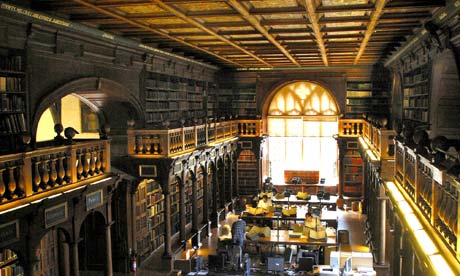
(Photograph: John Downing/Rex, The Guardian)
Dreaming is golden.
We All Have an Ocean View
Information is addicting. Plain and simple. Those NBC commercials titled, “The More You Know” always spark an internal curiosity in me. Watching those brief messages on the weekend from NBC personalities is like taking a swig of Knowledgeade.
I’m ready to go Mr. Lauer!
Aside from these brief, uplifting messages are a myriad of other outlets before us that present nearly unlimited opportunities for discovery and insight. The access to information on a daily basis is astonishing in the 21st century. It’s even borderline mesmerizing considering the world once existed and functioned well before a printing press was invented, let alone the pre-Internet era. Consider this: a phone is actually a computer first, with its calling capabilities down to probably third or fourth on the priority list of preferred functionality.
We all know it’s true. And if you think that’s an exaggeration, perhaps you are forgetting about the camera, your wide array of cool apps and your digital music player. Plus, don’t neglect the GPS (seriously, don’t neglect it).
Even the term “iCloud” has altered our perspective of the sky above us. No longer do we glance up into the open sky and blankly ponder the open space with imaginative daydreams. Instead, we look up and visualize data points and infinite transfers of structured and random information moving from Point A to Point B with a diagonal cut to Point S.
Is this a good evolutionary trait?
There are some nights when I look forward to relaxing and taking a break from writing papers and participating in the daily grind. Laying comfortably on a couch with a favorite show playing on the television in front of me, the urge becomes too overwhelming. I instantly (while simultaneously regretting it) open up my MacBook Pro that was closed and start searching for witty articles by a specific author or funny interview clips from a talk show.
On the one hand, it’s good that we are a people that is anxious and excited to seek and find new bits of information. Expanding our horizons should be viewed as a positive characteristic.
Still though, is it really positive that we’ve developed a never-ending quest for knowledge (traditional and non-traditional alike) that prevents us from taking necessary mental breaks?
On the knowledge front, we’ve all moved to the beach with a beautiful ocean view. Everyday, we look out into the vast blue, shimmering openness with the ambition to learn something new, knowing full well that complete knowledge is impossible. We take the dive regardless. On Wednesday, it’s waves hitting a bunch of rocks we see far to the right that stirs our inquisitiveness. On Thursday morning, we see surfers, which makes us want to learn about the history of surfing. Friday evening shows us fun being enjoyed on the boardwalk. Something clicks in our minds that we find too irresistible not to explore.
The rocks, surfers and people on a boardwalk represents something different to each of us. Regardless, these are topics we now find ourselves searching about…virtually nonstop.
While we may be exhausted, we are still seeing things we may never be able to or think to see again.
It’s a classic dilemma.
Speaking of classic…
I Have a Question…Actually, I Have More Than One
Why do we watch? Despite the fact it’s become a cultural phenomenon to millions of people, why do we, individually, sit on a couch and decidedly press the buttons on the controller that take us to The Discovery Channel for “Shark Week?” To discover something new I suppose.
“Shark Week,” in the literal sense, is a week of documentaries and informative stories about sharks, their habits, dangerously incredible close-ups, new revelations and so forth. In the metaphorical sense, it’s an opportunity over several days to revert back to our instincts of elementary school. What does this mean exactly? Reflecting on our experiences from kindergarten through the fifth grade, one of the constants was our insistence to learn as much about something that peeked our interest as possible. Whether it was sharks, bears, insects, adventures in books, sports, math, Sega Genesis, Nintendo, science, etc., we were hooked. We were not just thirsty for Capri Sun, but also for knowledge.
The amount of information we wanted to absorb was boundless. Do you think I’m wrong? If you have any nephews, nieces, sons or daughters around the preschool to elementary school age, try to compute just how many questions they ask you about anything and everything on a daily basis. Why? Why? Why!?
It’s their nature. It’s instinctive. Nobody tells them at a young age to ask a limitless amount of questions. They just do. Then, during the teenage years of our lives, we transition to a phase when we don’t seek as many answers to questions that are academically related. At some point though, we cycle back around to find the glow of knowledge from our younger days that rejuvenates an inner spark and desire to want to learn about what surrounds us and how everything works.
Who? What? When? Where? Why? How?
Some of you may be wondering why there were so many questions asked throughout this post? Because if nobody asks questions, how do we discover anything new? How do learn where we come from? How do we know where we are going? Where do great white sharks mate? Do sharks really mistake humans for seals? How do painters dream up their masterpieces? Do aliens exist? Will somebody ever invent a teleportation device? How has there not been a new “Bill & Ted’s” adventure made in more than twenty years?
This week, it’s sharks. What will it be tomorrow? The day after that? Next week?
Good question.
Extreme Makeover: Knowledge Edition
Upon first glance at today’s cover page on bing.com, I was baffled. As is protocol with viewing Bing’s daily front page, I scrolled over the image to navigate to one of the four informational boxes. The link took me to a collection of pictures of the University of Zurich Library.
Stunning.
The big, dramatic curves guide your eyes within its grandiose space. This description is hardly ever used to characterize a library. Most of us know libraries to be very quiet, calm and non-exciting. The need for such fancy, eye-catching exterior and interior designs is considered nonsense when referring to a place to read, write and study.
Maybe this is the problem.
Books, periodicals, research journals, magazines, movies and so forth remain popular commodities with the public for various reasons. Despite the demand and ample supply on the shelves, libraries are rarely packed from wall-to-wall, unless it’s mid-term or finals season. As a solution, I suggest more libraries search out for private investment collaborations. Specifically, imaginative minds, inventors and architects who would jump at the opportunity to make his or her mark. Living in the age of information (ie- digital technologies), libraries offer an outstanding and nearly unlimited resource for people to invest their time and energies to further their education and personal enlightenment.
Think of it as “the knowledge renaissance.”
It’s time to view libraries as not just a building filled with old books and shushing librarians, but instead a destination of learning. In other words, it’s time to follow the lead of some around the United States and the world in their recent and historic efforts to boldly brand libraries as, generally speaking, “a cool place to be.” The silence must be upheld, along with the other proper rules and norms for any library. Learning and expanding one’s mind still need to be the predominant objectives. The primary difference is making the trip to the library an experience for people of all ages with dynamic and innovative educational value, attraction and content.
To better illustrate my point, below is a small collection of some creative takes on the library:
 (Keystone/Gaetan Bally)
The University of Zurich Library
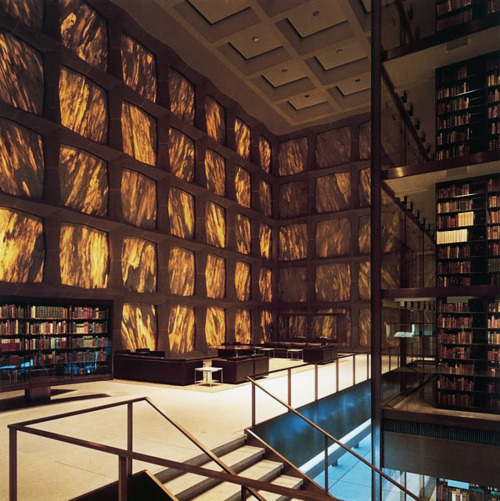 (STUA on Tumblr)
Yale University’s Beinecke Rare Book and Manuscript Library
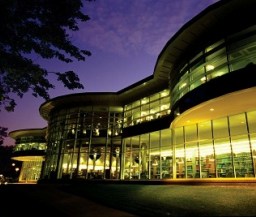
(princetonreview.com)
Arnold Bernhard Library at Quinnipiac University
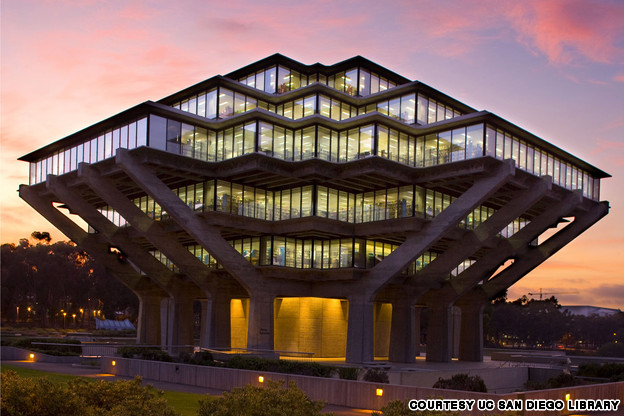 The Library at the University of California at San Diego

 (myloc.gov)
The Library of Congress
Above are only a few examples of how architects throughout history have defined libraries as spaces intended for learning whilst being surrounded by magnificent inspiration. Hopefully, the future will feature creative minds who expand on past and present designs (there really is something truly special about those old world libraries and the history they speak to its visitors…). Architects could also innovate these themes with entertaining and engaging technologies with the aspiration of uniting communities and people all around the world towards the journey of abundant knowledge and unparalleled perspective.
How does that phrase go, “if you build it, he will come.”
With all the technological advancements and varying mediums for sharing and presenting information, the grand opportunity to innovate, reinvigorate and redirect the public to the library in masses is undeniably present. Could this mean holographic shows with famous historical figures? Perhaps. There are seemingly countless possibilities. The key is finding and connecting with eager and imaginative men and women (like Ted Mosby, formerly of Mosbius Designs) to collaborate with to build these kingdoms of knowledge.
Kingdoms of knowledge…sounds like an adventure already.
 Jimmy's Daily Planet