Blog Archives
A Prehistoric Mindset
Even if bringing dinosaurs back to life births too many hazards (despite its eternal and forgiving human instinct and allure), scientists can never yield in the pursuit of comprehensive knowledge as to how these prehistoric creatures acted. And this all starts with their brains.
The recently released video below may not qualify as a leap, but it’s a fascinating step, to say the least.
There’s a new Michael Crichton-brand novel here…
Extending Our Brief History in Time
“If humanity is to continue another million years, our future lies in boldly going where no one else has gone before,” Hawking said, BBC reported.
Stephen Hawking continued his remarks.
“To leave Earth demands a concerted global approach, everyone should join in,” he said. “We need to rekindle the excitement of the early days of space travel in the sixties.”
He added one more thing.
“It is time to explore other solar systems. Spreading out may be the only thing that saves us from ourselves. I am convinced that humans need to leave Earth.”
You have our attention, Mr. Hawking.
The famed scientist made this bold delcaration at a recent arts and science festival known as Starmus. This event took place in Norway. Whether or not people or nations rush to join this intergalactic effort (aside from Dubai and the United Arab Emirates, what countries can afford this challenge right now?), the premise of rededicating ourselves to exploring the unknown of outer space is an exciting point to make in remembering America’s historically inspiring recent past. There are countless policies, specifically concerning the economy, entitlement reform and foreign policy/defense, that need to be crafted and enacted. Absolutely. Having said that, exploring space should jump back to being a national priority.
Instantly after reading Mr. Hawking’s eye-opening remarks, a specific film came to mind.
Christopher Nolan’s movies are always an experience and about something more than just the initial story and characters. And it seems that one of the leaders of the scientific community had more to say (knowingly or unknowingly) about the seemingly prescient cinematic event of 2014.
That cinematic event being Interstellar.
The Lesson: Watch more movies.
This Wasn’t a Small Step and It Wasn’t Made By Mankind
Hold on to your butts…
Some of the largest footprints known to science were made 70 million to 90 million years ago, when a type of dinosaur believed to be a titanosaur galumphed across the muck in central Asia.
—, The Washington Post
And that enormous foot left quite the impression.
“The footprint is one of the biggest known footprints in the world,” said Shinobu Ishigaki, a researcher at the Okayama University of Science in Japan and a member of the joint Mongolian-Japanese expedition to the Gobi, in an email to The Washington Post. The researchers announced their discovery of the footprint, roughly the size of a popular IKEA kitchen table, on Friday in Japan.

(Courtesy Shinobu Ishigaki/Okayama University of Science. Professor Shinobu Ishigaki lies next to a dinosaur print in the Gobi Desert)
As I’m writing this blog post on a kitchen table from IKEA, the picture above really hits close to home.
Joyous discoveries like the one made by Professor Shinobu Ishigaki is a great reminder of the wonder of this world, particularly with what roamed the Earth long before us. Thankfully, Michael Crichton and Steven Spielberg brought dinosaurs to life beyond the dusty pages of a book sitting on the shelf in 1993. Our minds have been blown ever since. Yes, being hunted by two velociraptors in a kitchen would be absolutely terrifying. Still, there’s a significant part of you that wants to be in Jurassic Park when watching the movie. The adrenaline to understand the known (and ironically unknown) characteristics of dinosaurs is what fuels our universal love and curiosity for the prehistoric creatures. That feeling is clearly expressed in Professor Ishigaki’s face in the picture above from a footprint left tens of millions of years ago.
What would it be like to witness a footprint the size of an IKEA kitchen table being made at the point of impact?
Jurassic World: You’re up.
Clever Owen.
Nothing Theoretical About It
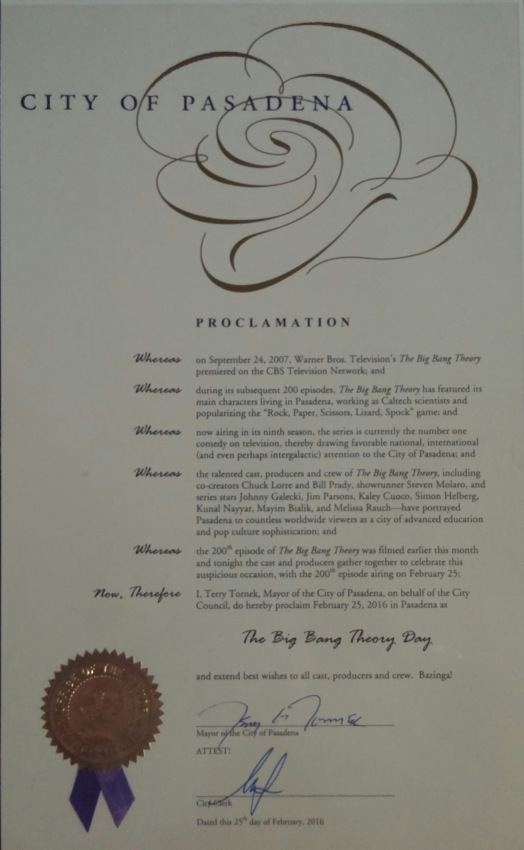
(City of Pasadena, William Boyer)
This is not a show prop.
To celebrate tonight’s 200th Big Bang Theory episode (with a cameo from TV’s Batman Adam West), the real city where the fictional show takes place made a real proclamation to honor the fictional show’s impact in the real world.
February 25th is officially, “The Big Bang Theory Day” in the southern California city that harbors scientific genius at Caltech and the most delicious cheesecake in Los Angeles. A good question to contemplate is whether the greater achievement is having a day dedicated to a show or that a show filmed its 200th episode with no signs of slowing down?
It’s like asking who wears tighter pants: Penny or Howard?
The science-based sitcom will, years after its finale (whenever that is) leave a sustaining mark on Pasadena. Many sitcoms are based in or generically around large cities, like New York, Chicago, Philadelphia, Seattle and Los Angeles. Few are set in a specific, real-life community. The setting for The Big Bang Theory has (evidently) become its own leading character. Real restaurants, streets, destinations and schools are frequently mentioned in the show’s dialogue and plot lines.
The city of Pasadena means many things to many people, residents and visitors alike. The Rose Bowl parade certainly comes to mind. Ultimately, Pasadena is a familiar suburb within opulent Los Angeles.
And now there’s proof that Pasadena is the spot for the amalgamation of science and comedy.
 Jimmy's Daily Planet