Blog Archives
Make Room (Or Space) for ‘Ad Astra’ on 9/20/19
It seems as if major Hollywood studios have unintentionally (or intentionally) designated this week as a new movie trailer week.
On that note, the list of movies that take place in space is long and expansive. As in really long and expansive. Particularly in recent years, there’s clearly been interest from moviemakers in LA and demand from audiences worldwide who want to travel to space via the silver screen sans the otherworldly price tag with acting’s biggest headline-grabbers. Just since 2013, films like ‘Gravity,’ ‘Interstellar,’ ‘The Martian,’ ‘Passengers,’ ‘Hidden Figures’ and ‘First Man’ (to name just a few) have explored space, based either on a true story or with a fairly high degree of realism within a fictional story to critical and box office success. Leading A-list actors and actresses in these aforementioned films include Sandra Bullock, George Clooney, Matthew McConaughey, Matt Damon, Chris Pratt, Jennifer Lawrence, Octavia Spencer, and Ryan Gosling.
And now fellow A-List actor Brad Pitt wants in on the action with his new space thriller called ‘Ad Astra,’ which is Latin for “to the stars.”
Interestingly, Liv Tyler portrays Brad Pitt’s wife who remains on earth while her husband ventures into the unknown in the heavens above for a mission revolving around the existence of this planet, which is oddly reminiscent of her role in the 1998 movie ‘Armageddon.’
Hmmm…
Anyways, the plot seems intertwined with exciting action sequences and personal relationships — near and far — that will surely reveal the true purpose of this film involving the enigmatic father character portrayed by Tommy Lee Jones as well as potentially ushering in the newest chapter in 21st-century science fiction. One of ‘Ad Astra’ director James Gray’s films is the 2015 documentary ‘Hitchcock/Truffaut.’ With this in mind, we should keep a keen eye on whether Mr. Gray (who wrote and directed ‘Ad Astra’) utilized any suspenseful techniques made famous by Mr. Hitchcock. For a movie that takes place in space with infinite scale, weaving in Hitchcock thrills via claustrophobia, for example, would bring a level of closeness to a story that will prioritize every ounce of available oxygen.
We know what ‘Ad Astra’ means in Latin, but what does it mean cinematically in 2019? Does the movie’s poster playfully reveal any clues?
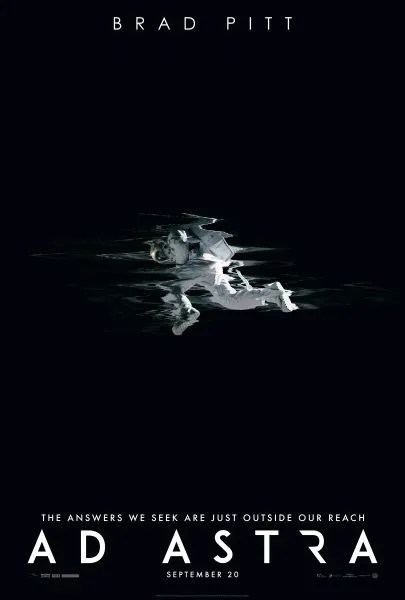
While the eye immediately goes to the astronaut’s warped movement in space — which is tantalizingly puzzling — why is the “R” in the title sliced in half in the poster? And then there’s the movie’s tag line, “The answers we seek are just outside our reach.” That suggests a new dimension in space with a Gandalf-caliber “You shall not pass” barrier. Where have we seen that before?
‘Ad Astra’ arrives in a theater near you on September 20.
A Record of Human History: The Hey-Side
For around a year, I’ve been waiting for a particular package to arrive. Patiently…waiting. No, it wasn’t late. This time, the package just took a while, and for legitimate reasons. The contents of which were going to be amazing and, honestly, out of this world when opened.
Well, at least a spectacular replica of something that was literally sent out of this world 40 years ago.
And this package arrived today!
As expected, the book, the albums and the disc sleeves are spectacularly designed and produced. It’s surreal to receive such a cool piece of history in the mail, courtesy of a Kickstarter campaign.
The fundraising and reward-based company Kickstarter has been good to a lot of innovators, dreamers and customers (like me) over the past several years. Thanks to Kickstarter, I’ve ridden a real-life hoverboard (no wheels, but an actual hoverboard that hovered above the ground in Silicon Valley), possess a limited edition board game inspired by Christopher Nolan’s epic film Inception (that came inside a silver briefcase) and can now play NASA’s famed Golden Records on a turntable and/or digitally.
Simply incredible.
If the Golden Record was re-recorded with a few new songs, images and earthly sounds today, one specific thing comes to mind above all the worthy contenders…
the B-movie masterpiece Independence Day.
Just as a nice reminder, in case the aliens ever got any ideas.
Extending Our Brief History in Time
“If humanity is to continue another million years, our future lies in boldly going where no one else has gone before,” Hawking said, BBC reported.
Stephen Hawking continued his remarks.
“To leave Earth demands a concerted global approach, everyone should join in,” he said. “We need to rekindle the excitement of the early days of space travel in the sixties.”
He added one more thing.
“It is time to explore other solar systems. Spreading out may be the only thing that saves us from ourselves. I am convinced that humans need to leave Earth.”
You have our attention, Mr. Hawking.
The famed scientist made this bold delcaration at a recent arts and science festival known as Starmus. This event took place in Norway. Whether or not people or nations rush to join this intergalactic effort (aside from Dubai and the United Arab Emirates, what countries can afford this challenge right now?), the premise of rededicating ourselves to exploring the unknown of outer space is an exciting point to make in remembering America’s historically inspiring recent past. There are countless policies, specifically concerning the economy, entitlement reform and foreign policy/defense, that need to be crafted and enacted. Absolutely. Having said that, exploring space should jump back to being a national priority.
Instantly after reading Mr. Hawking’s eye-opening remarks, a specific film came to mind.
Christopher Nolan’s movies are always an experience and about something more than just the initial story and characters. And it seems that one of the leaders of the scientific community had more to say (knowingly or unknowingly) about the seemingly prescient cinematic event of 2014.
That cinematic event being Interstellar.
The Lesson: Watch more movies.
Frank Sinatra Had the Right Idea
Fly me to the moon,
Let me play among the stars…
–Frank Sinatra, “Fly Me to the Moon”
Richard Branson and Elon Musk are planning to travel into space in the near future under the guise of private adventurism.
Add Naveen Jain to this growing list.
“The Federal Aviation Administration announced Wednesday that Moon Express, a firm co-founded by billionaire Naveen Jain, was approved to launch a suitcase-sized rover to the moon. Another company, Celestis, has reserved room for ashes and inert DNA samples.”
–Steven Nelson, U.S. News & World Report
Whether a rover, a commercial flight or the colonization of Mars, private citizens and their successful companies are revealing a paradigm shift that’s developing in extreme exploration.
Add movie director James Cameron to the list for oceanic exploration.
The dynamics of and success through globalization (increased customer base and, therefore, increased wealth potential and influence) is permitting a few of the craziest and most eccentric business leaders and firms to dream with their heads in the stars in a literal sense.
Given that many of the world’s most powerful economies are struggling and overwhelmed with more questions than answers, business leaders and ambitious innovators are taking advantage of their positive business ventures with inspired aspirations. Richard Branson (Virgin Galactic), Elon Musk (SpaceX) and Naveen Jain (Mon Express) are among the extreme explorers in the world today. Utilizing their winsome character, the reputations of the aforementioned dreamers attract followers nearly akin to Apple enthusiasts to the late Steve Jobs. There’s a sense that the world, in terms of space travel, is changing in a profound way and people want to be a part of this excitingly promising future.
The ingenuity, daring mentality and, perhaps most essential, the money is on the side of fun, personable billionaire private citizens.
Space travel in the 20th century was defined by the heroic crew of Apollo 11 (Neil Armstrong, Buzz Aldrin, Michael Collins) walking on the moon, courtesy of NASA, an integral part of the United States government. “That’s one small step for a man, one giant leap for mankind.”
Space travel in the 21st century will be defined by —
The smart money is with “private citizens.”
 Jimmy's Daily Planet