Blog Archives
They’re Gonna Need a Bigger Park
Will Jurassic World (executive produced by Steven Spielberg) redefine the summer blockbuster (created by Steven Spielberg in 1975 with Jaws) with dinosaurs brought to life/engineered from prehistoric DNA for the second time (Spielberg’s groundbreaking Jurassic Park in 1993) 40 years after the supremely terrifying, gigantic great white shark scared us from swimming in the ocean?

(Fan-Made Poster by Jeff Victor)
Jurassic World opens today!
With a theatrical release almost exactly 22 years after Jurassic Park (June 11th), the fourth installment in this treasured franchise is centered on new characters and some fun new dinosaurs. Written, directed and acted (Chris Pratt, Bryce Dallas Howard) by proud fans of the 1993 cinematic epic, there is a lot of pressure to get this film right. This is especially true because of its direct connection to the original movie, one of the greatest (if not the greatest) movies of all-time.
No pressure, right?
CGI will understandably be used, but needs to be coupled with an ideal balance of practical effects. Only the director and special effects team can make this judgement, but this will be a critical dynamic for how successful it will ultimately be as part of the movie-going experience. And, equally relevant, the effects will help determine the all-important shelf-life (literally) for fans months and years from now. Steven Spielberg hand-picked Colin Trevorrow, which should immediately add some gravitas and assurances to his decision to select a relative rookie for such a massive undertaking.
Living in a point in time in film history when over-reliance on CGI can overwhelm stories, characters and believability alike, hopefully Trevorrow took cues from Spielberg, Christopher Nolan and J.J. Abrams in their lauded approaches and spent the money and took the time to develop and incorporate stunning practical effects and sets into Jurassic World. This movie is a big deal for a variety of reasons, one of which is the inevitable comparisons of the effects and settings of 1993 v. 2015. Other key elements audiences will look for include edge-of-our-seat suspense, originality with homages to 1993, heart-racing twists-and-turns, relationships with genuine connections, as well as whether this film will feature life lessons within a grand vision built for today and tomorrow.
Plus, the story/script needs to sound like it came from a Michael Crichton novel.
The excitement for Jurassic World is palpable. Fans (like myself) have been waiting 22 years to visit a fully-functioning, state-of-the-art theme park with dinosaurs, having spared no expense. Yes, I’ve seen the original and understand the results and messages of the first film. I know that humans get in serious trouble when they attempt to control nature and that dinosaurs from 65 million years ago have instincts and behaviors that are incompatible with people. Still, who doesn’t want to be a part of that amazingly awesome adventure? What kid didn’t see themselves as Timmy or Lex in 1993? Dr. Grant? Dr. Sattler? Dr. Ian Malcolm?
Steven Spielberg is the master of projecting imaginative characters, worlds and quotable moments that have the spectacular power to entertain and impact lives far, far beyond opening night.
Hopefully, Mr. Trevorrow found a way with Jurassic World.
That Jurassic Labyrinth
On this day back in 1993, the world changed forever.
Steven Spielberg’s Jurassic Park was a tyrannosaurus-sized blockbuster that was the “Star Wars” for an entire generation that redefined cinema and changed everything about what movies could be and should be. It was the first movie to use CGI and, coupled with Stan Winston’s brilliant use of animatronics, created dinosaur effects that made the audience truly believe there was a modern day park with prehistoric creatures from 65 million years ago. This movie has everything: heart-pulsing action, dynamic characters and relationships, original storytelling (props to Michael Crichton), legendary soundtrack, epic surprises and iconic phrases and scenes.
Speaking of the latter, the following video clip is still arguably the most terrifyingly amazing scene from this cinematic masterpiece.
Just one more day until we get to see what Jurassic World will serve up…
The Spinning Top Generation

(Princeton University, Office of Communications, Denise Applewhite)
What did forthcoming Princeton University graduates want to hear this week as they prepare to enter the overwhelmingly expansive real world that’s full of twists and turns and unlimited pathways that are equal part linear and non-linear?
A speech from today’s cinematic and storytelling expert on grit, epic realities and dreams: Christopher Nolan.
“In the great tradition of these speeches, generally someone says something along the lines of ‘Chase your dreams,’ but I don’t want to tell you that because I don’t believe that,” he told the students at Class Day. “I want you to chase your reality.”
One of the constants in movies by Nolan is that regardless of the setting, everything is realistic (and yes, this applies to those astonishing dream sequences). He proposed a novel idea in his speech: aspiring to our desired reality. This certainly includes, Inception, which he referenced to and added just a little context to that excruciatingly famous ending.
Instead of floating off onto a cloud above our reach towards the bright light of our dreams, he wants us to pick a reality and do anything we have to do to reach it. Like his movies, the main protagonist(s) are thrown into extraordinary situations, yet they choose to battle whatever barriers stand in their way. However psychologically draining or physically dominating their enemy/wave/tumbling hallway is, we must feel the bumps in the road on our feet, the rain on our faces and feel terrified by the surrounding thunder and lightning.
Why?
Because we have the knowledge to achieve a lot, but it’s only by testing and adjusting this knowledge through life’s unsuspecting experiences that we will ultimately learn how to reach and become our coveted reality. In essence, Nolan’s message is to add practicality to our journey and future, no matter the environment:
A dream is above us, but reality is in front of us.
I think the students listening were just glad that he adjusted the mind-bending element of his speech down from 90% to 70%.
You could say that was a bit of a dream come true.
There’s Time to Discover Another Dimension
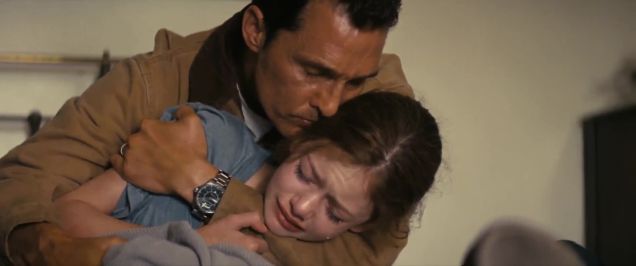
(io9)
“Confusion gives us the opportunity to find clarity’s stretched-out hand”
–Me
The above quote was inspired by today’s Blu-ray release of Interstellar. Fans of the emotional operatic space epic finally have limitless time to watch and re-watch the Christopher Nolan Sci-Fi classic in an effort to connect the dots together.
Have no fear, the nearly 3-hour gargantuan of a film (see what I did there) has a quick, entertaining pace.
The best movies leave the audience thinking about the story and its key message(s) long after leaving the theater. They strike a nerve (see picture above). Movies, regardless of how refined or goofy, need to have a purpose. And it’s the films that present something that’s larger than life that have the greatest impact and lasting impressions on people. This goes for Jaws, Jurassic Park, Titanic, The Godfather, Citizen Kane, The Sound of Music, Ghostbusters and The Breakfast Club (to literally only name a few).
Think about it: 1, 5, 10, 20, 30, 50 and even 74 years later, modern society still talks about a wide-range of movies and their impact several decades later for a variety of reasons. This timeless fact is why release dates like today are so exciting. Watching Interstellar in your living room will be astonishing with its green screen-free visuals, pulsating soundtrack, excellent acting and exhilarating twists and turns. But, in the big picture, it’s the latest example of a great movie’s second-life. It will earn itself a permanent spot on people’s movie shelves. This is one of those films that will be enjoyed multiple times because there will always be something new (no matter how small) that will be seen with each viewing.
To help with that, Paramount Pictures included “3 hours of bonus features!” and an IMAX film cell with the Blu-ray and DVDs. My film analysis teacher in high school taught me that we need to see a movie 3-4 times to completely see everything the director wanted us to see. The story won’t change, but it’s fascinating to focus on different things to bring the experience together all the more. Example: Appreciating the intricate detail of the specific books that were placed on the bookshelf in the beginning of the movie. Or when Steven Spielberg recorded how Lincoln’s pocket watch would have ticked in the 1860s. And, quite honestly, to enjoy the movie all over again!
“My films, if people go to them worrying about whether they’ll understand and approach it like a crossword puzzle, they’re not going to get as much out of it. You’re meant to go along for the ride,” Nolan said.
Thankfully, there’s now no line for the epic ride of Interstellar.
 Jimmy's Daily Planet