Blog Archives
Announcing a Flat Formation
At the end of a metaphorical 90 minutes (more than 20 years literally), this is what U.S. Soccer and Nike came up with:
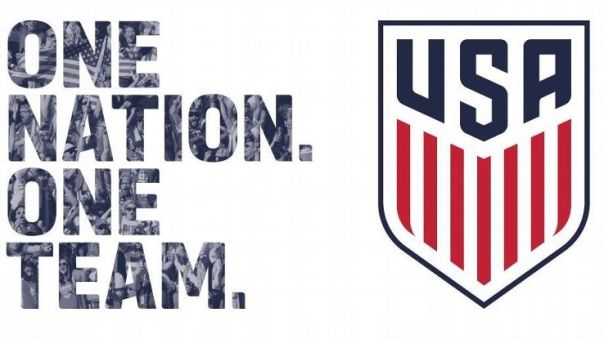
- A crest with 13 vertical stripes of red and white under a blue field is a traditional American style.
- Seven red and 6 white stripes come directly from our flag, demonstrating that the crest is rooted in the history of our nation.
- Uses the traditional field of blue to celebrate the three most important letters in the vocabulary of our fans, from stadiums to watch parties to the local bar – U.S.A.
- The colors stay true to our nation’s colors with the red and blue drawn straight from the flag.
- Notably, the new identity no longer features stars or a ball. In soccer tradition, stars are placed above the logo to represent World Cup victories. The WNT crest will prominently feature the three stars earned in 1991, 1999 and most recently, the historic 2015 victory.
(U.S. Soccer)
The new crest has uniquely American features (as listed above), yet it lacks imagination and declarative strength. This is the symbol of this burgeoning sport in America and the first impression is strikingly plain and boring.
Where is a bald eagle in striking position? The snake nobody should dare tread on?
There are countless creative design ideas that could have/should have been brainstormed for this branding endeavor.
Where is the ingenuity, that defining characteristic of soccer and this country? What does this crest convey to ourselves and our competitors? How does this new crest represent our heritage and a future of excellence?
There are 13 stripes, yes. The colors are red, white and the right shade of blue this time, yes. However, how did a design team at Nike, a company that prides itself on creativity and branding (cough cough Oregon football), submit this idea without it being April 1st? What does this crest possibly inspire for new jersey designs?
The United States of America broadly, and soccer in America specifically, has always been about a brighter tomorrow. But the new crest is a straight-forward graphic that doesn’t really tell us anything about yesterday, today or tomorrow.
U.S. Soccer desperately needs a vivid and cohesive identity on the pitch.
Flat and humdrum has already been done.
Soccer’s Headache?
“The U.S. Soccer Federation is recommending a ban on headers for players 10 and under, limits for players between 11 and 13 and having medical professionals rather than coaches make decisions on whether players suspected of concussions can remain in games” (AP)
For the past few years, I have been forecasting a future with youth soccer that would see school districts impose headgear requirements for its players. The helmet (of sorts) would likely be soft-shell, as worn below by current Arsenal goalkeeper Petr Čech who suffered an unusually brutal injury nine years ago.
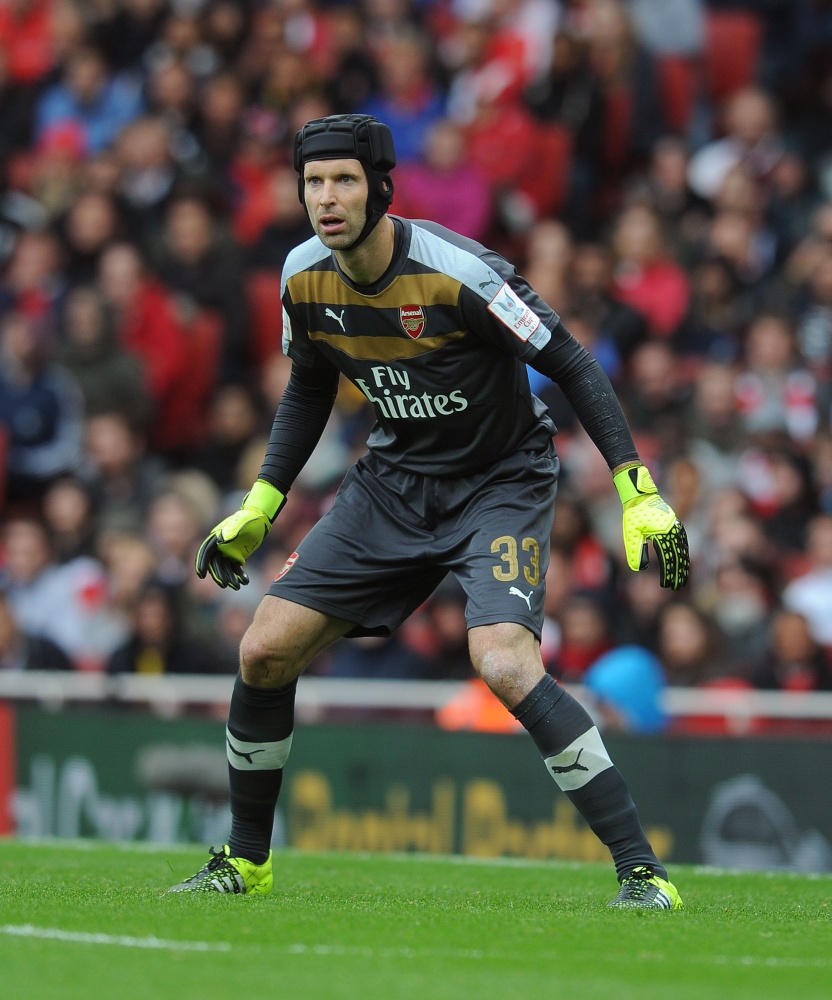
(Arsenal.com)
“The depressed fracture of the skull that Cech suffered in a clash with Reading’s Stephen Hunt threatened his life. His skull is thinner than average – possibly as a result of being born a triplet – and he will have to continue wearing his protective rugby-style cap for the next two years at least”
–Duncan White, Telegraph, 2008
The two factors going forward in this debate will be safety and reality.
Everyone wants players to be safe, but at what point does it cross into over-protection?
Petr Čech’s injury is an extreme anomaly. Precautions can and should be taken. Safety is a paramount concern. Concussions and head injuries do happen in this sport. Any player suspected of suffering a concussion or potential head injury needs to be examined and taken care of in the best way possible.
The proposed solution as a whole, however, seems to be bordering on the excessive. If parents don’t want kids to play or kids don’t want to play because of this fear, then don’t play or stop playing. That’s fine. It’s that simple. And to be clear, this recommendation doesn’t come with any attitude.
That’s just the reality of the beautiful game and life.
P.S. Headers are bad for the sport?
Finding the Right Mix
Super-subs.
Jürgen Klinsmann does not always put out the best starting 11, but he is quite deft at rotating the right players in at the right times for maximum returns late in games.
Example?
Just take last night’s stand-out second-half substitutions during the Americans’ World Cup send-off match against Azerbaijan (their head coach is now literally on Klinsmann’s United States Men’s National Team staff for Brazil and is a long-time friend) at the ill-fated (yet energetic) Candlestick Park in San Francisco, California.
Mix Diskerud and Aron Johannsson.
These names have been mentioned in this blog before as being key players for the USMNT and for Brazil in particular. Each player added positive evidence to this hypothesis last night. Granted, it was a home match against the 85th-ranked team in the world, but there was virtually no flow from the middle-to-final third before they entered.
Johannsson subbed for Chris Wondolowski in the 61′ and Diskerud came on for the flat Alejandro Bedoya in the 71′, noticeably sporting #10, Donovan’s old number. And by old, I mean four days or so.
Speedster DeAndre Yedlin also came off the bench for Fabian Johnson in the 61′ and played a fair game.
The game was nil-nil in the 61′. What was the final score? 2-nil USMNT with goals from Diskerud and Johannsson.
Making a statement? Yes.
The match opened-up immediately after Johannsson started running around up top with some much needed purpose towards scoring goals and the flow looked as nice as Diskerud’s waving brown mane following his entrance. Just four minutes after Mix was added to the mix (c’mon, it’s right there), he scored off a rebound just outside the six-yard box that originated from a Michael Bradley half-volley at goal.
#10 to the rescue.
Regarding the #10 shirt, Diskerud had the ideal response in his post-match interview with ESPN’s Jeremy Schaap.
“For me it is just a number. I am playing for what is in front of the jersey, not what is in the back or my name.”
Classy answer.
Aside from the fact that Clint Dempsey had minor groin pain and didn’t play, the quick takeaways are that the central defense is still shaky, the outside defense is shaky, the outside midfielders need to be more creative and daring on the flanks, starting forward Jozy Altidore has apparently adopted the Jairo Arrieta theory of playing up top without scoring goals and that the young 23-year old players in Mix Diskerud and Aron Johannsson need to be subs and/or starters in every group game this summer.
While Diskerud and Johannsson are both relatively new to the national team universe, they clearly play with an energetic and inventive chip on their shoulders that results in positive contributions and results. Johannsson wants to score whenever he plays, which is always a good thing to have in a forward. Just saying.
And Mix Diskerud and Michael Bradley are the perfect complement to each other. Diskerud is right-brained and Bradley is left-brained and together they can create a dangerous dynamic for the USMNT in the middle of the pitch. This team needs leadership and this coupling could very well be the stable and imaginative core this squad needs for pulling off any last-minute heroics or improbable upsets in Brazil.
Diskerud and Johannsson as super-subs? Yes.
However, if match-ups on the field permit it, super-starter also has a nice little ring to it. I’m looking at you, Mix.
Either way, Klinsmann finalizes the lineup. It rests with him in deciding if the summer of 2014 will be a memorable World Cup experience for the Americans.
Will Klinsmann be a super coach in Brazil?
USMNT fans hope so.
 Jimmy's Daily Planet