Blog Archives
Electrically Engineering a T into a 3
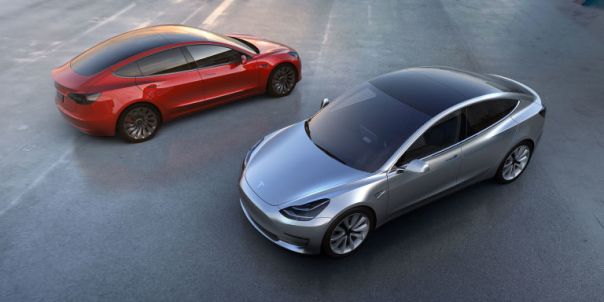
(Tesla Model 3)
Tesla Motors is the conservative argument for positively responding to climate change/global warming/global cooling/environmental issues.
Tesla announced Thursday that it has received 325,000 preorders for its recently unveiled Model 3. If it sells every car that’s been reserved, the company says it will earn enough revenue to make this the “biggest one-week launch of any product ever.”
–Andrew J. Hawkins, The Verge
One single car using gas or one single power plant is not the problem, but it’s the cumulative effect of millions of drivers or hundreds of power plants that has a meaningful impact on the release of carbon emissions into the air. Therefore, with cars, the goal is to present the marketplace with affordable, high-quality options.
Enter Elon Musk and his burgeoning company, Tesla Motors, that’s appropriately named after famed inventor Nikola Tesla.
This tech-driven company (see what I did there) is clearly being rewarded by anxiously excited followers for its ingenuity, hard-work, determination and recognition of a demand that’s marketed to a large portion of the American people to consider and even reserve for purchase next year.
Innovation is and has always been the right path towards a bright future that empowers the individual and then, as a result, empowers the collective. One electric car will not make a difference, but millions of electric cars on the road will change the carbon emissions equation. The power of individualism, innovation and opportunity must be taught and encouraged to this generation and future generations because of the incentives and the how inventiveness has benefited societies throughout history.
The iPhone was not dreamed up because of a tech regulation. Neither was the transportation revolution known as Henry Ford’s Model T, which was the first affordable automobile designed, built and produced for the American people roughly 100 years ago.
The close rhyming between 3 and T was a nice touch, Mr. Musk.
Conversely, what sense does it make to penalize consumers/the public with environmentally strangling regulations (especially without a Kung Fu grip on Mother Nature) and policies that punish people and companies? Photo-ops at these high-profile gatherings, where the focus is to cast blame and then reward a relatively select few participants with control and influence over the many, doesn’t project a hopeful future, especially when the measures taken amount to a gesture instead of a silver bullet.
Fiscal pain and high-minded barriers will not solve substantial problems. By high-minded, that refers to opponents of industries some deem unacceptable (like coal), but who have no better or ready alternatives for those workers who need to feed and provide for themselves and/or their families. Nobody likes pollution and some regulations are good and necessary, but, like government, figuring out policies to keep the regulatory code as small as possible is best.
There’s a paramount difference between idealism rooted in reality (conservatism) and idealism floating around in fantasy (liberalism).
Regardless of the extent that people across the political spectrum believe in global warming or global cooling (100%, 50%, 25%, 7.4%), the most important issues going forward are agreeing on a common goal and determining the most intelligent and economical approach.
We should strive for a carbon emissions-free future, achieved through empowering the engine of innovation.
In many cases,
- Innovation = Revolutions by and for the people
- Regulation = Power, control and influence over the people by and for a select few
$27,500 for the Tesla Model 3 (with $7,500 tax credit).
This inviting price point will attract car buyers in the 5-Star safety rated, 5-seat sedan in the $25K-$35K market, which will directly challenge car models from household names Toyota and Honda and even Lexus, Mercedes and Audi. If the Model 3 is successful and proves to have a reliable re-charging infrastructure and if (the recommended) nightly charging pattern for the 215-mile battery range like your smartphone results in a future worth the investment, then the conversation to join the names Elon Musk and Henry Ford in the same sentence in history books will begin.
People, once again, have an opportunity to change the world by buying a car.
Tesla Motors is a prime example of dreaming big, showcasing the power of the individual, American ingenuity and supplying a demand that could very well revolutionize cars, the transportation grid and solving a problem with carbon emissions in the environment with a positive, captivating solution that’s generating a magnetic appeal to its products and brand.
The Model 3’s engine may be nearly silent, but it still sounds like a revolution…
Time to Fold on TV
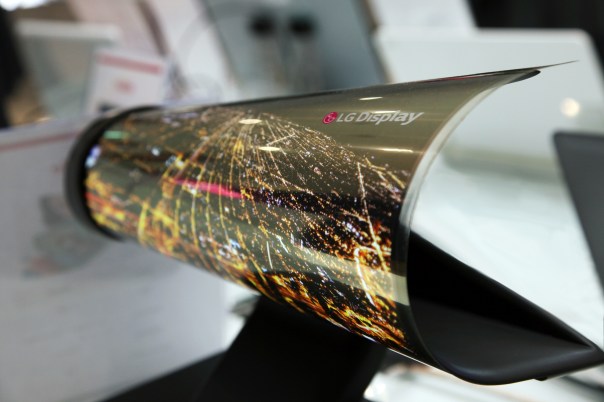
(LG Display)
“The company will also showcase futuristic concept displays that highlight the dynamic forms that OLED can achieve, including the world’s first 30R 18-inch rollable display that can be rolled-up like a newspaper…”
(LG Press Release)
The January 4, 2016 press release from technology giant LG (Life’s Good) disclosed many exciting products in-and-out of development for the annual forward-thinking Consumer Electronics Show in Las Vegas. Specifically, the OLED screen that bends with impressive flexibility and resolution presents a unique opportunity for a more convenient future.
As phones and tablets continue to increase in size and inflexibility (iPad Pro, damn), there is a natural instinct to ponder if a Zack Morris phone-wave is upon us?
Keep in mind that retro is always in style, especially the nineties.
Fortunately, LG may have just changed shrunk rolled the game back to size while peeking forward towards what may be commercially sold during the forthcoming third decade of the 21st century.
Envisioning LG’s flexible screen for televisions makes anyone impossibly curious about how TV-watching will change in the future. The question that comes to mind is if we (consumers) will actually have the option to roll up a high-definition TV like the Wall Street Journal and carry it to any flat surface in our home and simply stick it up like a magnet on a fridge?
Crazy.
The even crazier question: Who’s been bringing the Fruit Roll-Ups to LG’s innovation lab?
Back to the Future We Love
Ringtone set to the Back to the Future theme? Check.
Wearing a dark red t-shirt that reads, “Hill Valley High School Alumni 1985” with a bulldog on it? Check.
Wearing Calvin Klein underwear and faded blue jeans? Check.
Started my car’s engine and proceeded to say, “Roads? Where we’re going, we don’t need roads“? Check.
Listened to Alan Silvestri’s soundtrack to Back to the Future: Part II in the car this morning? Check.
Rode a real-life hoverboard made by Hendo Hover in the year 2015? Check!
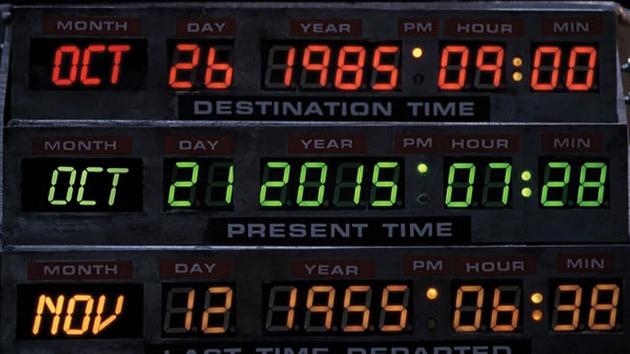
(ABC 6 WPVI-TV)
Happy Back to the Future Day everyone!
While Pepsi Perfect is currently working out how to salvage its dynamite promotion idea to sell the futuristic beverage of choice for Marty McFly on October 21, 2015, let’s celebrate the amazing franchise of Back to the Future. Directed by Robert Zemeckis, written by Bob Gale and starring Michael J. Fox, Christopher Lloyd, Crispin Glover, Thomas F. Wilson, Lea Thompson, Claudia Wells (and Elisabeth Shue), this time traveling science-fiction phenomenon and pop culture epic is the epitome of the best of what a “B-movie” can be. It’s original, has action, is funny, has heart and feels bigger than a something we see on a screen (like a 3-D Jaws…).
It aces every category!
Back to the Future captured our imaginations, our dreams and electrified the idea that anything is possible. We can choose to make our future bright and everything we want, just as long as we’re willing to stand-up to and battle the Biff Tannens of the world. When I was younger, my family and I visited Universal Studios and we rode in and experienced the Back to the Future ride in Orlando, Florida. Waiting in line was actually fun, especially when we got prepped about out mission in Doc Brown’s lab. And “experience” is the key word with this trilogy and it’s one of the reasons why this series remains so meaningful to us after all these years. It was so much more than just movies from the ’80s.
The Back to the Future trilogy really does underscore “the power of love.”
Now, the time has come to see the future…on October 21, 2015.
And Nike, the day has literally come to power-lace our heart strings!
P.S. Come on Cubbies!
No Lions in Paris
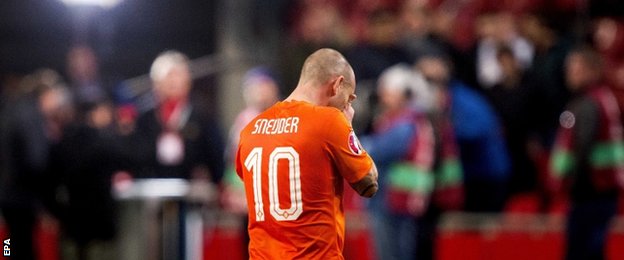
(EPA)
Dutch tourism to France may be at an all-time low next summer.
The Netherlands soccer team suffered a devastating 3-2 loss today against the Czech Republic, who were not very kind visitors in the Amsterdam Arena. Missed opportunities for goals throughout 93 minutes, porous defending in the back and Robin van Persie’s miscalculation that resulted in an own goal sealed their fate.
It should be noted van Persie did score against the Czech Republic, along with Klaas-Jan Huntelaar.
Since the Dutch were hanging by a thread of hope and a prayer (a must-win game and Iceland victory) before kickoff, the odds against their qualifying for the playoff to then qualify to the UEFA Euro 2016 tournament in France were very high.
Still, the Oranje players and dedicated fans (myself included) had faith in an epic turnaround.
Despite injuries to key players (including, but not limited to Arjen Robben, Jasper Cillessen and much of its defense), it was expected that the Netherlands would be able to control its games and earn enough wins and ties to book its ticket to France in the summer of 2016.
They didn’t.
“…Netherlands finished fourth in the group and failed to qualify for the European Championships for the first time since 1984…”
–Tom Webber, Goal.com
Great teams in all sports experience injury woes that can paralyze their chances at grand success. Some of these teams manage to squeeze out wins, even when the odds were all against them. Even though the Dutch have had their pitfalls throughout its history (internal turmoil, lack of motivation), they have also had moments of glory and the best kinds of shock-and-awe. Just last summer, the Dutch finished third in the World Cup.
And this is where this defeat stings the most.
The expectations were and are sky high for this squad, as in a championship-level altitude. Some of the best players in the world are on this team. Let’s take a closer look with their age in parenthesis:
- Arjen Robben (31)
- Wesley Sneijder (31)
- Robin van Persie (32)
- Klaas-Jan Huntelaar (32)
- Rafael van der Vaart (32)
The fact is those listed above, a golden generation in their own right, have world-class talent, pace and vision. Age has not slowed them down. However, the reason for listing the aforementioned players who define the explosive and creative offense identity of the Dutch is to acknowledge that this was the last UEFA Euro tournament they could have competed for within their peak years.
As a tried-and-true Dutch fan for more than 15 years, it’s painful to even concede this reality.
The final score today was a disqualifying loss, but the opportunity to play for and potentially win a defining European championship was the real loss and it was (and is) gut-wrenching.
There are many questions to be answered in the coming days, weeks, months:
- Is head coach Danny Blind to blame when he had such a limited, bleak chance of success?
- Who will be the head coach for the 2018 World Cup qualifying?
- What players listed above will be leading the Dutch towards the next World Cup in Russia?
- Aside from Daley Blind, can the Netherlands find high-quality defenders?
- How quickly can this team fix its problems and return to playing world-class soccer/Total Football?
Fortunately, the KNVB’s current golden generation has a proficiency for answering its harshest critics every couple of years. They have one more chance lift a trophy to solidify their golden Oranje legacy.
From Russia, with love of strength and the World Cup trophy, 2018 is the mission of a lifetime.
 Jimmy's Daily Planet