Blog Archives
Cuatro a Cero Sounds Good Too
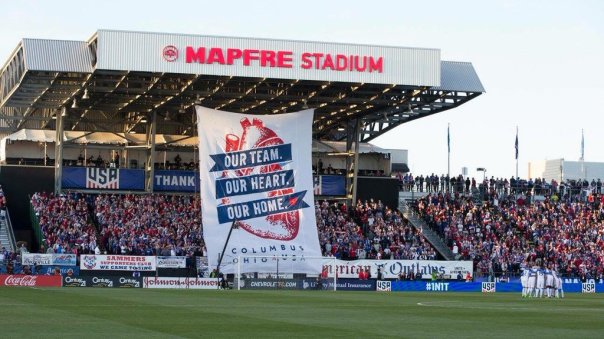
(MAPFRE Stadium Twitter)
First: Columbus, Ohio is THE undisputed soccer capital of the United States of America.
Second: WWJCD?
(What would Johan Cruyff do?)
As tributes from the Netherlands to Spain and all around the world continue for the recently deceased footballing legend Johan Cruyff, his name should be on the minds of the USMNT (United States Men’s National Team) and its fans.
Why?
When you consider the confusing insistence of Jürgen Klinsmann to use the same players who struggle to win big games against top teams (and lesser opponents), who lead squads that lack any apparent tactical purpose, how is anything going to change without making a big change at the top. Mr. Klinsmann selects his players and decides who plays and who he develops.
Too many players who should be on the pitch gaining valuable experience aren’t getting genuine opportunities to play and improve, which is ironic given Jürgen’s prowess for recruiting young, dual-citizenship talent.
The 2-nil loss at Guatemala this past Friday was shocking, but, sadly, not entirely surprising. Guatemala is not a powerhouse by any stretch of the imagination and if the 95th FIFA ranked CONCACAF foe becomes the standard for success, the USMNT is really in trouble. And this is why Cruyff should be on the minds of American coaches, players and fans tonight and in the near future.
Johan Cruyff’s style was/is world-class that looks like a high-stakes, speed-infused master level chess game. However, don’t be fooled, it takes tremendous vision, hard work and talent to execute his philosophy. Most teams can get results just playing for the win. But teams with an objective focused on carrying out a grand strategy with complex, purposeful movement and possession that can attack at will, while simultaneously simplifying the game with clarity and mesmerizing with creativity are commonly referred to as champions.
Is this how you would currently describe the USMNT?
Win or lose tonight (I predicted a win), Jürgen Klinsmann’s future should still be discussed with pressing questions going forward. My vote has been for a new coach for quite some time now. The issue isn’t just advancing in World Cup qualifying, but whether or not the USMNT product on the pitch can play against, and not just chase, the best teams in the world.
Granted, Klinsmann and Co. delivered a massive win in a massive stadium when they needed a victory. 4-nil warrants congratulations. The goals were great and the atmosphere was incredible. At Crew Stadium, the USMNT team has won 8 games, including 7 World Cup qualifiers with absolutely zero losses.
Once again, well done Columbus!
However, is keeping Klinsmann as manager worth risking another underwhelming 4-year World Cup cycle?
That’s the massive question leaving Columbus, Ohio.
P.S. Local fan favorite Ethan Finlay was clearly onside when he scored.
FIFA’s Questionable Call
What is the opposite of a shocking revelation?
“While acknowledging for the first time that votes were bought in past World Cup hosting contests, FIFA is seeking to claim “tens of millions of dollars” in bribe money seized by U.S. federal prosecutors.”
–Associated Press
Then there’s this.
“FIFA claims it is the victim of corrupt individuals, despite widespread criticism that bribe-taking was embedded in its culture in the presidencies of Joao Havelange and Sepp Blatter, who was forced from office after 17 years by the current scandal.”
–Associated Press
Should we be shocked at this point?
First, there have been countless assertions throughout the past decade of institutions failing all around us. Remember though, it’s not so much the institutions failing as much as the people running those institutions who are letting people down.
Second, when leaders in powerful positions are revealed as corrupt, the guilty parties should/need to recognize and sincerely apologize for their deceit and/or willful ignorance to the public. Sadly, this doesn’t appear to be the stance of FIFA. When widespread hearsay became an infuriating reality for the global soccer organization in the summer of 2015, one presumed a 180-degree turn in tone and approach.
One would be wrong.
Does FIFA have a legitimate gripe?
In a courtroom, perhaps.
In the real world, seen through the lens of soccer’s most impassioned fans?
Everyone roll your eyes and put your hands in the air with a dispirited expression aimed into the unknown.
Soccer doesn’t have instant replay, but FIFA’s assertions certainly requires a second and third look to be believed for its specious contention.
At first glance, it looks out-of-bounds.
Announcing a Flat Formation
At the end of a metaphorical 90 minutes (more than 20 years literally), this is what U.S. Soccer and Nike came up with:
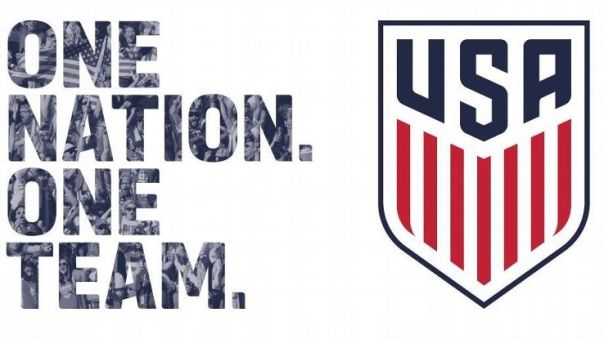
- A crest with 13 vertical stripes of red and white under a blue field is a traditional American style.
- Seven red and 6 white stripes come directly from our flag, demonstrating that the crest is rooted in the history of our nation.
- Uses the traditional field of blue to celebrate the three most important letters in the vocabulary of our fans, from stadiums to watch parties to the local bar – U.S.A.
- The colors stay true to our nation’s colors with the red and blue drawn straight from the flag.
- Notably, the new identity no longer features stars or a ball. In soccer tradition, stars are placed above the logo to represent World Cup victories. The WNT crest will prominently feature the three stars earned in 1991, 1999 and most recently, the historic 2015 victory.
(U.S. Soccer)
The new crest has uniquely American features (as listed above), yet it lacks imagination and declarative strength. This is the symbol of this burgeoning sport in America and the first impression is strikingly plain and boring.
Where is a bald eagle in striking position? The snake nobody should dare tread on?
There are countless creative design ideas that could have/should have been brainstormed for this branding endeavor.
Where is the ingenuity, that defining characteristic of soccer and this country? What does this crest convey to ourselves and our competitors? How does this new crest represent our heritage and a future of excellence?
There are 13 stripes, yes. The colors are red, white and the right shade of blue this time, yes. However, how did a design team at Nike, a company that prides itself on creativity and branding (cough cough Oregon football), submit this idea without it being April 1st? What does this crest possibly inspire for new jersey designs?
The United States of America broadly, and soccer in America specifically, has always been about a brighter tomorrow. But the new crest is a straight-forward graphic that doesn’t really tell us anything about yesterday, today or tomorrow.
U.S. Soccer desperately needs a vivid and cohesive identity on the pitch.
Flat and humdrum has already been done.
 Jimmy's Daily Planet