Blog Archives
Redefining Immortality
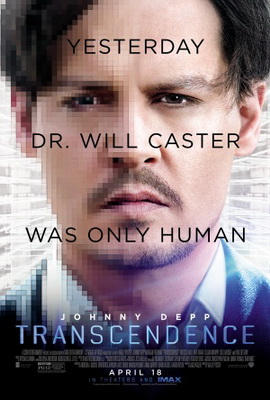
(Source: Wikipedia)
Transcendence will project on movie screens all around the United States today. As a science-fiction thriller, first-time director (and acclaimed cinematographer) Wally Pfister and his all-star cast (Johnny Depp, Morgan Freeman, Rebecca Hall, Kate Mara, Cillian Murphy, Paul Bettany) will pose surprisingly relevant questions about the current state of mankind and womankind and whether racing on the autobahn of developing increasingly personal technologies and building machines with only “pure upside” is the road we should be taking. Or, at the very least, at the speed innovators appear to driving their savvy imaginations in this day and age.
Can (or should) humans live forever, consciously, inside a computer?
The term “the grid” is taking shape and evolving in ways many of us either didn’t think was possible or were, quite frankly, fearful of. Once this mainframe is built (or perhaps it already is), is it even possible to dismantle it?
There are infinite questions to be pondered from this movie and other science-fiction thrillers. For instance: What does artificial intelligence look like today? What is its true reach? Is that reach good or bad?
Some may think that technology is tinkered with in basement facilities with pale walls, computers, wires and varying degrees of limitations. But what if the concept of “the cloud” is as unlimited and open as its sounds?
This blog has written about technology before, including its benefits and drawbacks. Without seeing Transcendence, an opinion cannot rightly be rendered. But this film presents a couple hours to escape into a creative and entertaining story of artificial intelligence and the pursuit of advanced technology on a Friday or Saturday night, as well as to take a moment to pause and reflect on the subject matter.
How long until we are in the “age of transcendence” as defined by Pfister and Co.? What does this mean for society as individuals, as well as the collective? Is the infinite space above and all around us becoming finite and controlled without us knowing? Should it be if it’s guided by a genius?
There’s one way to find out and it’s called Transcendence, playing in a theater near you.
Maybe we should ask Siri about transcendence…
If 2008 Was a Song
When the music stops, in terms of liquidity, things will be complicated. But as long as the music is playing, you’ve got to get up and dance. We’re still dancing.
–Chuck Prince, former CEO of Citigroup
Relating the financial sector to the popular children’s birthday game of musical chairs. That’s definitely one way to look at it.
One movie that continues to replay in my mind is, “Margin Call.” The cast consists of Kevin Spacey, Stanley Tucci, Zachary Quinto, Paul Bettany, Jeremy Irons, Demi Moore and Simon Baker. Not bad. The film takes place in real time during the course of 24 hours and explores a “fictional” New York investment firm that discovers its books are overwhelmed with volatile, and therefore, unsustainable assets.
Everything is about to hit the fan.
Would you like to wager a guess as to when it takes place?
All the warnings signs in the film were willfully ignored and the mountain they now had to climb was higher and more treacherous than anything the executives responsible could begin to imagine in his or her worst nightmare.
Oddly enough, it’s not just the movie that continues to remain in the back of my mind, but equally so is the music. If you go the website, “margincallmovie.com,” a song will play on repeat. The music contains zero lyrics and is downright foreboding.
There’s only so much of it I can listen to an one time until I need to hear something upbeat and fun. Still, I continue to return on occasion.
My peculiar and reluctant addiction to this song could partly be drawn from reflecting on how surreal 2008 really was, as well as the general uneasiness that’s been felt around the country for the past five years. We all know what happened in 2008. We’ve all felt the devastating effects in our lives in some way. And yet, this specific soundtrack continues to play. Nobody has stopped this music. And not just pertaining to Wall Street, but all the fiscal problems that have accumulated over time and are quickly (and obviously) reaching the boiling point with regard to government spending, debt, entitlements, etc.
There is not a universal feeling that we’ve left 2008 in the past, nor that the government is taking the necessary steps to reach solvency in the future or to implement policies to spark a people-based comeback in the now. For too many, this song and its ripple effects have not yielded. This chapter keeps adding pages, read by weary and exhausted eyes.
What’s next?
Any real discussion to curb the country’s enormous debt, deficit and entitlements is not being seriously addressed by those with the power to ultimately change the unbelievably predictable equations riddled with unsustainable constants and variables.
Incredibly, the beat goes on.
It’s not enough to believe that time alone will raise the United States from the ashes like the phoenix. Instead, this situation demands prudent fiscal policy. It will require very tough decisions. It will require sincere leadership. Like a can being kicked, the mute button won’t hide or bury the soundtrack from 2008, but alternatively needs a completely new orchestral arrangement…and conductor.
Have you ever had a song stuck in your head for a week? It’s annoying.
Imagine five years and counting.
People don’t want the music to stop, they just want to hear something different. They want to hear something optimistic and assuring, complemented with inspiring lyrics. They want a song or collection of songs written and performed for a new era in America.
All I can say is musical chairs used to be fun.
 Jimmy's Daily Planet