Monthly Archives: August 2013
Extreme Makeover: Knowledge Edition
Upon first glance at today’s cover page on bing.com, I was baffled. As is protocol with viewing Bing’s daily front page, I scrolled over the image to navigate to one of the four informational boxes. The link took me to a collection of pictures of the University of Zurich Library.
Stunning.
The big, dramatic curves guide your eyes within its grandiose space. This description is hardly ever used to characterize a library. Most of us know libraries to be very quiet, calm and non-exciting. The need for such fancy, eye-catching exterior and interior designs is considered nonsense when referring to a place to read, write and study.
Maybe this is the problem.
Books, periodicals, research journals, magazines, movies and so forth remain popular commodities with the public for various reasons. Despite the demand and ample supply on the shelves, libraries are rarely packed from wall-to-wall, unless it’s mid-term or finals season. As a solution, I suggest more libraries search out for private investment collaborations. Specifically, imaginative minds, inventors and architects who would jump at the opportunity to make his or her mark. Living in the age of information (ie- digital technologies), libraries offer an outstanding and nearly unlimited resource for people to invest their time and energies to further their education and personal enlightenment.
Think of it as “the knowledge renaissance.”
It’s time to view libraries as not just a building filled with old books and shushing librarians, but instead a destination of learning. In other words, it’s time to follow the lead of some around the United States and the world in their recent and historic efforts to boldly brand libraries as, generally speaking, “a cool place to be.” The silence must be upheld, along with the other proper rules and norms for any library. Learning and expanding one’s mind still need to be the predominant objectives. The primary difference is making the trip to the library an experience for people of all ages with dynamic and innovative educational value, attraction and content.
To better illustrate my point, below is a small collection of some creative takes on the library:
 (Keystone/Gaetan Bally)
The University of Zurich Library
 (STUA on Tumblr)
Yale University’s Beinecke Rare Book and Manuscript Library
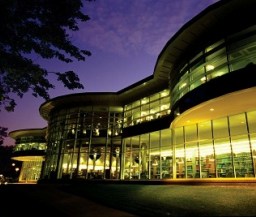
(princetonreview.com)
Arnold Bernhard Library at Quinnipiac University
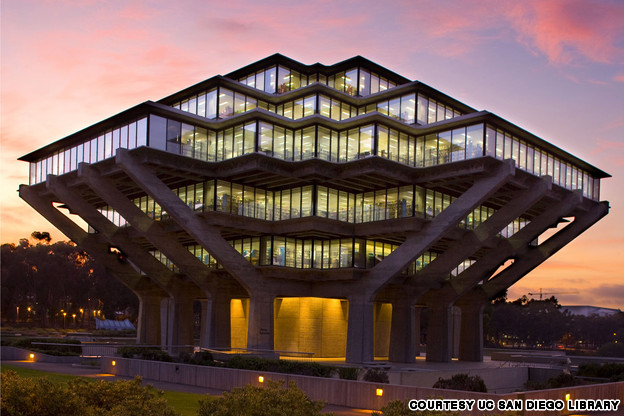 The Library at the University of California at San Diego

 (myloc.gov)
The Library of Congress
Above are only a few examples of how architects throughout history have defined libraries as spaces intended for learning whilst being surrounded by magnificent inspiration. Hopefully, the future will feature creative minds who expand on past and present designs (there really is something truly special about those old world libraries and the history they speak to its visitors…). Architects could also innovate these themes with entertaining and engaging technologies with the aspiration of uniting communities and people all around the world towards the journey of abundant knowledge and unparalleled perspective.
How does that phrase go, “if you build it, he will come.”
With all the technological advancements and varying mediums for sharing and presenting information, the grand opportunity to innovate, reinvigorate and redirect the public to the library in masses is undeniably present. Could this mean holographic shows with famous historical figures? Perhaps. There are seemingly countless possibilities. The key is finding and connecting with eager and imaginative men and women (like Ted Mosby, formerly of Mosbius Designs) to collaborate with to build these kingdoms of knowledge.
Kingdoms of knowledge…sounds like an adventure already.
The Crew 2.0
According to thecrew.com, San Francisco’s Anthony Precourt of Precourt Sports Ventures, LLC has become the new owner of the Columbus Crew. Remarkably, Preourt is only the second owner of “America’s Hardest Working Team” since its 1996 inception as a Charter Member of Major League Soccer. Yesterday marked not only the transition from the legendary Hunt Sports Group, but also represented a seismic shift in the operations and management of the Columbus Crew.
Ceremonial jubilation aside, a significant dynamic has been created. After Precourt was handed the keys to America’s first soccer-specific stadium, he and his company just may have turned the front office of the Columbus Crew into an up-and-coming venture capital start-up…with 18 years experience and championships on the shelf, including 2008’s MLS Cup.
Throughout the Crew’s long history, patience has been a cornerstone of the organization. There are several instances of when this has been a tremendous asset. This degree of trust is a unique quality in today’s fast-paced world. Conversely, if things started to go poorly, at least in the eyes of the dedicated fans, the front office has been quite glacial to make any drastic and necessary changes. A prime example of this mentality is the fact that Robert Warzycha is still the head coach.
However, successful businesses do not operate with this much elasticity. Data points are constantly analyzed and debated, with necessary adjustments made when appropriate. Precourt, and this is only from an initial impression, appears to be of the mindset that success does not occur when one is losing. Again, Warzycha is still the head coach. Spending the past five seasons watching the same movie on repeat has gotten old and frustratingly predictable.
Crew fans are very cognizant that Warzycha was the head coach that directed the team that won the MLS Cup in 2008 under head coach Sigi Schmid to a squad that couldn’t win a playoff game in 2009.
The point is that Precourt and his business partners appear interested in obtaining success while simultaneously appealing to and growing the incredible fan base in Ohio’s capital city. It’s potentially an adaptation of the European football culture: treating the team, roster and results like a business, while engaging fans, creating a fun atmosphere and generating a lovable brand. He said in a recent interview that success begins on the pitch.
And I can safely assert that every Crew fan hopes he intends to begin with the field located in Columbus Crew Stadium.
 Jimmy's Daily Planet